Winston Churchill Wartime Prime Minister Questions: Life in the UK Test 2026 Cheat Sheet
Success on the Life in the UK Test 2026 depends on candidate recall regarding winston churchill wartime prime minister questions. Chapter 3 of the official third edition handbook grounds its 20th-century historical module in the cabinet choices of Sir Winston Churchill during the 1940 Battle of Britain and the Blitz. Achieving the compulsory 75% pass mark—18 correct responses out of 24 total items—determines whether an applicant advances their British citizenship application or indefinite leave to remain settlement requirement. Mastery of administrative dates, radio addresses, and his 1951 return to power governs candidate outcomes on examination day.
1. Executive Cheat Sheet & Core Summary
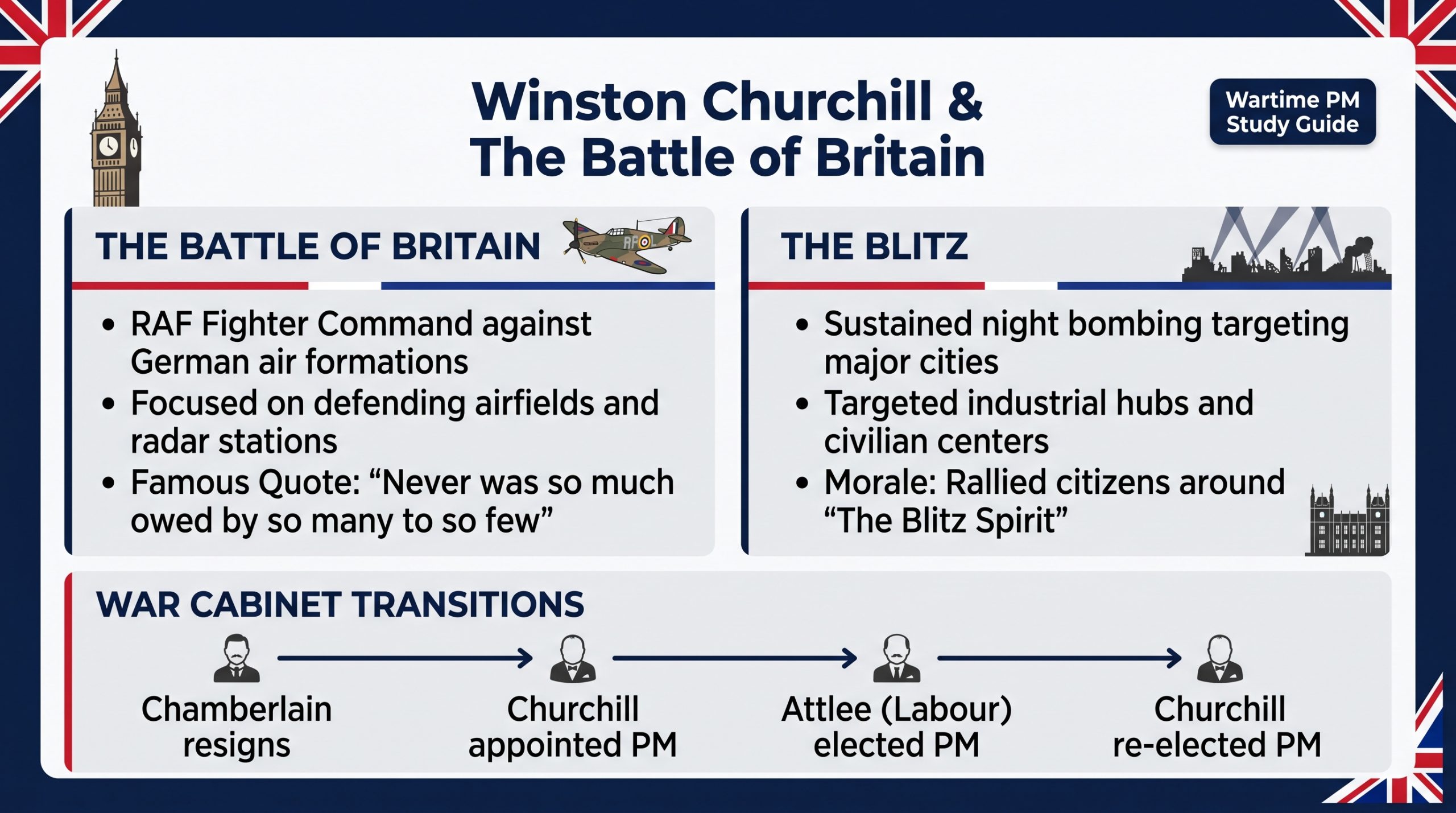
Following Neville Chamberlain’s resignation in May 1940, Churchill assumed direction of a cross-party coalition government. Emergency defense mobilization proceeded alongside nationwide broadcasts intended to stabilize civilian resolve. In an address to Parliament during the air combats of 1940, Churchill commended Royal Air Force pilots: “Never was so much owed by so many to so few.” Electoral control shifted to Clement Attlee and the Labour Party in July 1945. Churchill reclaimed executive office after the 1951 general election. Candidates completing practice assessments must separate political shifts from military timelines.
| Key Metric / Entity | Official Handbook Rule | Exam Trap Warning |
|---|---|---|
| Prime Minister Term 1 | May 1940 – July 1945 | Churchill taking office in May 1940 remains distinct from the earlier resignation date of Chamberlain. |
| Famous Quotation | “Never was so much owed by so many to so few” | This statement applies to Royal Air Force aircrews in 1940. It does not apply to infantry forces evacuated at Dunkirk. |
| The Blitz (1940–1941) | Nightly aerial bombardment targeting industrial hubs and urban population centers | Examination questions require candidates to separate daylight air battles over the English Channel from night raids on cities. |
| Post-War Election | Defeated in 1945 by Clement Attlee; regained power through his 1951 re-election | Incorrect test choices state that Churchill served without interruption throughout the entire decade of the 1940s. |
2. Official 3rd Edition Handbook Breakdown: Churchill & World War II
The handbook highlights Sir Winston Churchill’s wartime government as a primary focus for the history module. By mid-1940, Allied forces faced total expulsion from continental Europe. Churchill refused peace terms from German representatives. Directing state resources toward coastal defense, his administration prepared for an impending invasion. Memorizing these administrative actions helps candidates answer winston churchill wartime prime minister questions accurately.
Historical Chronology & Key Background
Parliamentary support for Neville Chamberlain collapsed in May 1940. Churchill formed an all-party administration shortly thereafter. Operation Dynamo proceeded immediately, extracting over 300,000 Allied soldiers from the beaches of Dunkirk. This naval action preserved trained infantry divisions. Those rescued troops provided the ground defenses necessary to resist Operation Sea Lion, the planned German invasion of Great Britain. German bombers commenced raids over southern counties once air battles initiated.
Dogfights defined the Battle of Britain between July and October 1940. Fighter Command retained control over British airspace and prevented the Luftwaffe from securing air dominance. Churchill delivered radio addresses via the BBC throughout the crisis. These broadcasts maintained public endurance despite daily air attacks.
Key Figures, Dates & Legal Legislation
Applicants submitting documentation for a British citizenship application or settlement verification must memorize specific historical records and dates:
- 1940 (The Crisis Year): Churchill became Prime Minister in May; the Dunkirk evacuation concluded in June; the Battle of Britain spanned July through October.
- “The Few”: Churchill addressed the House of Commons on 20 August 1940, stating: “Never was so much owed by so many to so few.”
- The Blitz (September 1940 – May 1941): Luftwaffe formations executed night raids against London and Liverpool. Churchill inspected damaged urban zones directly to evaluate civil defense operations.
- 1945 General Election: Clement Attlee led the Labour Party to a parliamentary majority in July 1945 because voters prioritized social welfare reforms.
- 1951 Re-election: Churchill secured his 1951 re-election at age 77, remaining Prime Minister until his resignation in 1955.
3. Comparative Analysis: Battle of Britain vs. The Blitz (1940–1941)
Candidates sometimes confuse military operations conducted during 1940 and 1941. The official 24 questions exam evaluates whether applicants can differentiate air defense targets from tactical goals and historical quotes. Reviewing comparative tables helps candidates avoid errors on examination day.
| Feature / Criteria | The Battle of Britain (1940) | The Blitz (1940–1941) |
|---|---|---|
| Primary Target | Royal Air Force airfields, radar stations, and communication hubs | Industrial cities, shipping ports, and residential areas |
| Key Combatants | RAF Fighter Command against German air formations | German night bombers against civilian defense forces and ground artillery |
| Churchill’s Associated Quote | “Never was so much owed by so many to so few” | Inspirational messaging regarding civilian resilience during night bombing |
| Strategic Outcome | German air forces failed to achieve air dominance, an outcome that forced the cancellation of invasion plans | Civilian casualties were high; factory output and administrative functions continued operating |
4. Interactive Practice Test & Exam Drills
Testing memory through practice questions supports revision. Candidates can evaluate their preparation level by completing practice items based on handbook facts. These drills include single-choice questions, true or false items, and questions with two correct answers.
Question 1: In which year did Winston Churchill become Prime Minister for the first time?
View Correct Answer & Rationale
Correct Answer: C) 1940
Official Rationale: Churchill became Prime Minister in May 1940 after Neville Chamberlain resigned. Option A refers to the 1938 Munich Agreement under Chamberlain. Option D marks the year Churchill lost office to Clement Attlee after the general election.
Question 2: Who was Winston Churchill commending when he stated, “Never was so much owed by so many to so few”?
View Correct Answer & Rationale
Correct Answer: B) Royal Air Force (RAF) fighter pilots in the Battle of Britain
Official Rationale: Churchill delivered this phrase during an August 1940 parliamentary speech. The statement expressed gratitude to Royal Air Force aircrews who defended British airspace against German air attacks during the Battle of Britain.
Question 3: True or False: Winston Churchill served as Prime Minister continuously from 1940 until 1955.
View Correct Answer & Rationale
Correct Answer: B) False
Official Rationale: The statement is false. Labour Party leader Clement Attlee defeated Churchill in the general election of July 1945. Churchill led the parliamentary opposition until he regained the premiership in the 1951 election.
Question 4: Which TWO statements regarding Winston Churchill are correct? (Select TWO options)
View Correct Answer & Rationale
Correct Answer: B and C
Official Rationale: Examination questions with two correct answers test distinct sections of the official handbook. Churchill governed as wartime Prime Minister and received the Nobel Prize in Literature in 1953. Option A contains an incorrect historical period. Option D is incorrect because Churchill led the Conservative Party.
Question 5: What was “The Blitz” during World War II?
View Correct Answer & Rationale
Correct Answer: B) The night-time bombing campaign directed against British cities by the German air force
Official Rationale: The term “The Blitz” refers to the systematic night-time bombardment of London and other industrial centers by the German air force between September 1940 and May 1941.