
Stonehenge vs Skara Brae: Life in the UK Test Comparison
Executive Summary: Preparing for the Life in the UK Test 2026 isn’t just about memorizing names—it’s about spotting how the Home Office frames specific history questions. Chapter 3 (“A Long and Illustrious History: Early Britain”) focuses heavily on Neolithic landmarks. Two sites stand out above the rest: Stonehenge down on England’s Salisbury Plain, and Skara Brae tucked away on the Orkney archipelago in Scotland. Miss the core distinctions between them, and you’ll throw away easy points. Here is the exact breakdown you need to pass on your first attempt.
1. Deep Time: How Chapter 3 Frames Prehistoric Britain
It all starts long before Roman legions set foot on British soil in 55 BC under Julius Caesar or launched Claudius’s full-scale invasion in AD 43. Life in the United Kingdom: A Guide for New Residents opens its narrative arc with the Stone Age—specifically the pivot from nomadic foraging to settled farming in the Neolithic Era (roughly 4000 BC to 2500 BC).
Early Britons chopped throughout dense forest cover, planted crops like wheat and barley, domesticated wild stock, and began raising stone structures that outlasted their own cultures. Without written records, physical ruins do all the talking.
The Home Office loves testing this material.
They pick two specific locations—Stonehenge and Skara Brae—to measure whether you understand how early islanders lived, engineered, and organized their communities before metals took over.
2. Sacred Geometry: Decoding Stonehenge
Rising out of Wiltshire’s rolling landscape, Stonehenge remains Britain’s iconic prehistoric marker—though its construction wasn’t a single event. It took over a thousand years. Work began around 3000 BC with a simple ditch-and-bank circular enclosure, but things escalated dramatically around 2500 BC when massive stones started moving across vast distances.
Think about the sheer logistics involved here.
Smaller “bluestones” traveled roughly 140 miles from the Preseli Hills in southwest Wales; giant “sarsen” monoliths came from quarries 15 to 20 miles to the north. Builders didn’t just stack them—they cut interlocking mortise-and-tenon joints, transferring timber-framing concepts directly into solid rock.
Nobody lived inside this circle. It wasn’t a town, and it wasn’t a defensive fort; it was a gathering ground aligned with the winter sunset and summer sunrise, functioning as a ceremonial axis and high-status burial space (cremation remains tucked into the Aubrey holes prove as much).
3. Domestic Survival: Uncovering Skara Brae
Perched right along the Bay of Skaill in Orkney, Scotland, Skara Brae gives us Europe’s best-preserved snapshot of Neolithic home life. It was settled around 3180 BC, housing families for about six centuries before being abandoned near 2500 BC.
A ferocious 1850 winter storm tore away the coastal sand dunes, exposing hidden stone walls that had sat buried for millennia.
Ten individual houses stand linked by covered stone tunnels. Because trees couldn’t survive the brutal Atlantic winds, islanders built everything out of slate-like flagstone—sinking homes into heaps of refuse (“midden”) to insulate themselves against severe sea storms. Inside, you’ll find uniform furnishings: central hearths for fire, built-in stone dressers, slab beds once stuffed with heather, and sunken floor basins used for bait or seafood prep. That extraordinary level of preservation is why historians constantly refer to it as the “Scottish Pompeii.”
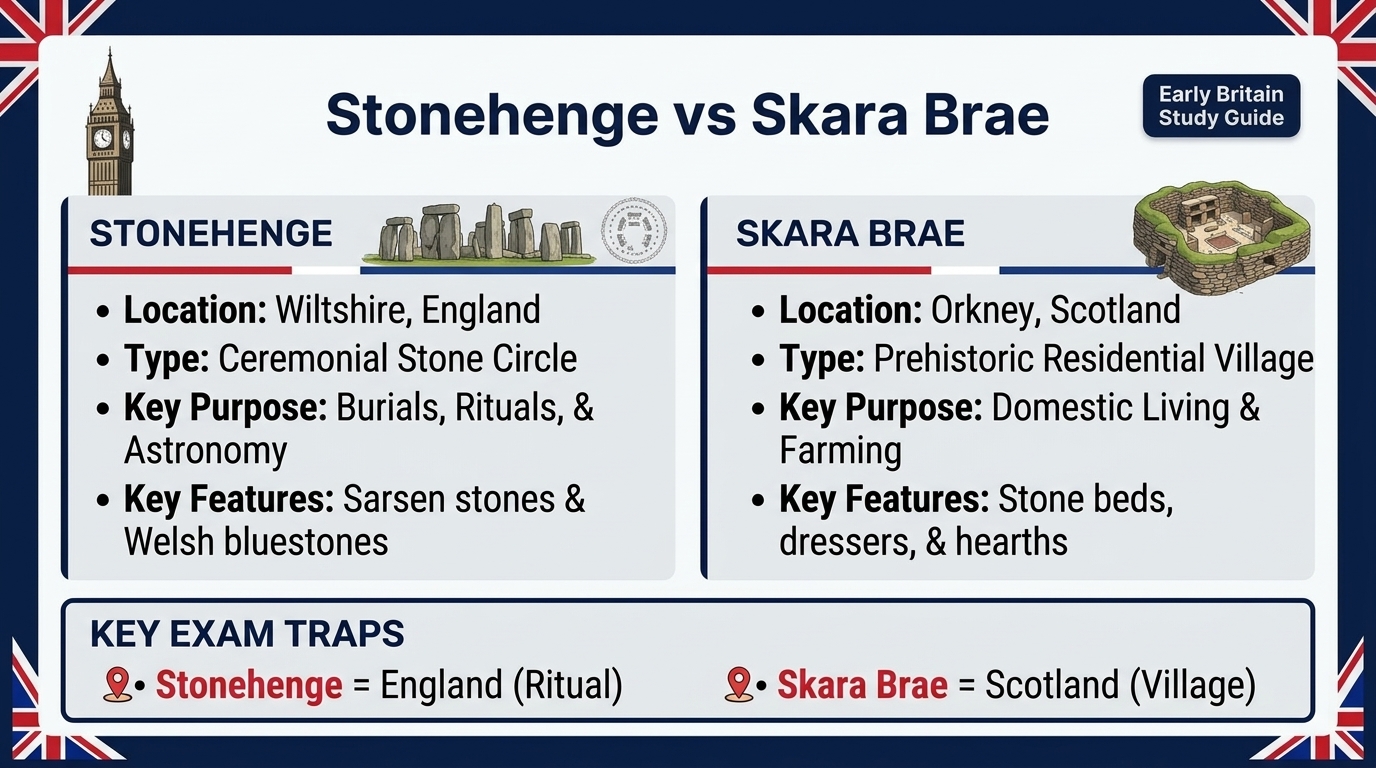
4. Side-by-Side: Monumental Earthwork vs. Domestic Village
You can’t afford to blur these two together on test day. While both belong to Neolithic Britain and showcase incredible craftsmanship, they answered completely different human needs.
| Feature / Attribute | Stonehenge | Skara Brae |
|---|---|---|
| Geographic Location | Salisbury Plain, Wiltshire, England | Mainland, Orkney Islands, Scotland |
| Primary Classification | Stone Circle / Ceremonial Earthwork | Prehistoric Residential Village |
| Approximate Date | Earthwork ~3000 BC; main stones ~2500 BC | Inhabited ~3180 BC down to ~2500 BC |
| Function | Rituals, Burials, Solar Alignments | Everyday Domestic Living, Shelter, Farming Base |
| Key Features | Sarsen blocks, Welsh bluestones, Lintels, Mortise joints | Stone beds, dressers, hearths, covered tunnels |
| Official Body / Status | English Heritage / UNESCO Site | Historic Environment Scotland / UNESCO Site |
5. Where Test-Takers Stumble: Classic Home Office Traps
The Home Office doesn’t just ask straightforward facts—they write options meant to catch careless readers off guard. Watch out for these three recurring patterns:
1. Swapping Nations: The test will often pair Skara Brae with England or Stonehenge with Scotland. Remember: Stonehenge belongs to Wiltshire (England), while Skara Brae belongs to Orkney (Scotland).
2. Age Confusion: Options might try to trick you into classifying these sites as Iron Age hill forts or Roman settlements. They aren’t. Both originated in the Neolithic Age (New Stone Age).
3. Mixed Identities: Watch out for sneaky phrasing like “Skara Brae is a famous stone circle in southern England.” That’s completely wrong—it mixes the village function of Orkney with the stone structure of Wiltshire.
6. Practice Drills & Real Rationale Breakdowns
Work through these sample questions to see how concepts transform into actual exam items.
Question 1: Where is the prehistoric stone circle monument of Stonehenge located? (Choose ONE)
Correct Answer: Wiltshire, England
Official Rationale: Chapter 3 explicitly places Stonehenge on Salisbury Plain in Wiltshire (South West England). Skara Brae is located in Scotland.
Question 2: What type of historical site is Skara Brae on the Orkney Islands? (Choose ONE)
Correct Answer: An exceptionally well-preserved prehistoric village / settlement
Official Rationale: Skara Brae is a Neolithic residential community complete with stone houses, hearths, and stone furniture—not a military fort, temple, or standing circle.
Question 3: True or False: Stonehenge was built as a residential village for early British kings.
Correct Answer: False
Official Rationale: Stonehenge was built for gathering, astronomy, and sacred burial rituals. Prehistoric Britons didn’t live inside the circle—domestic life took place in timber structures or stone villages like Skara Brae.
Question 4: Which historical period saw the construction of both Skara Brae and the earliest phases of Stonehenge? (Choose ONE)
Correct Answer: The Stone Age (Neolithic Period)
Official Rationale: Both landmarks date back over 4,000 years to the Stone Age. They predate the Roman invasion (55 BC / AD 43) and the Norman Conquest (1066) by millennia.
7. Frequently Asked Questions
Q: Do I need to memorize exact dates like 3180 BC for the Life in the UK Test?
Answer: You don’t need to stress over exact calendar years like 3180 BC. What matters is knowing which broad era a site belongs to—in this case, the Stone Age (Neolithic Period)—and how it aligns relative to later events like the Roman arrival or Norman Conquest.
Q: Are there other ancient sites mentioned in Chapter 3 of the official handbook?
Answer: Yes, you’ll also see references to Maiden Castle in Dorset (an Iron Age hill fort) and Roman defensive structures like Hadrian’s Wall. Still, Stonehenge and Skara Brae remain the centerpiece examples for Stone Age questions.
Q: Where can I review official study materials for the Life in the UK Test?
Answer: Official test details, handbook updates, and registration portals can be found through the government’s portal at GOV.UK Life in the UK Test.