Stonehenge Midsummer Solstice :New Key Differences & Test Traps for Life in the UK Exam
Most candidates walk into the test center assuming their general knowledge will pull them through that’s a quick way to fail. The Home Office examiner doesn’t care about modern Druid gatherings or complex carbon-dating debates you watched on television. They test precise, unyielding phrases straight from Chapter 3: a Neolithic monument in Wiltshire built for seasonal gatherings, aligned explicitly with the midsummer sunrise and midwinter sunset. Master those exact handbook phrases and you won’t fall for the exam traps.
1. Stonehenge & Solstice Alignment: The Bare Essentials
Chapter 3 of Life in the United Kingdom: A Guide for New Residents (“A Long and Illustrious History”) drops candidate pass rates when it pivots to prehistoric monuments. The Home Office syllabus isolates Stonehenge as the ultimate flagship of early British stone circles. Located down in Wiltshire, its construction date traces back to Stone Age farming communities who needed communal markers for seasonal tracking.
Miss one keyword and you lose points. It’s that simple.
| Key Metric / Legal Entity | Official Handbook Rule | Common Exam Trap |
|---|---|---|
| Geographic Location | Wiltshire, England | Confusing location with Skara Brae (Orkney, Scotland) |
| Historical Era | Stone Age (Neolithic period) | Mistakenly classifying it as Bronze Age or Iron Age construction |
| Astronomical Alignment | Midsummer sunrise and midwinter sunset | Selecting spring or autumn equinoxes as official test answers |
| Primary Function | Gathering place for seasonal ceremonies | Confusing handbook wording with modern religious or burial claims |
Lock these four facts into memory before moving forward.
2. What the 3rd Edition Syllabus Actually Tests
Roughly 6,000 years ago, hunter-gatherer bands across Britain gave way to early agriculturalists the first farmers who cleared forest land, established permanent settlements, and began erecting massive stone structures. Stonehenge remains the handbook’s core example. According to official text, these Stone Age settlers didn’t build it overnight; they dragged and shaped colossal megaliths in present-day Wiltshire to serve as a central hub for seasonal rituals. You can check official background context through English Heritage or review citizenship testing policies directly on GOV.UK.
Precision matters here. The stones align directly with the rising sun on the year’s longest day the midsummer sunrise and point straight toward the setting sun on the shortest day (the midwinter sunset).
Don’t overthink this during the test. Examiners don’t care about bluestones transported from Welsh quarries, carbon-14 revisions, or competing theories from academic archaeologists. They care whether you know three things: Stone Age origins, Wiltshire location, and solar alignment during midsummer and midwinter.
Watch out for seasonal tricks on test day. Midsummer means June’s longest day, midwinter means December’s shortest distractors will throw in “spring equinox” or “harvest festival” to catch unprepared candidates off guard.
3. Spotting Distractor Traps & Historical Eras
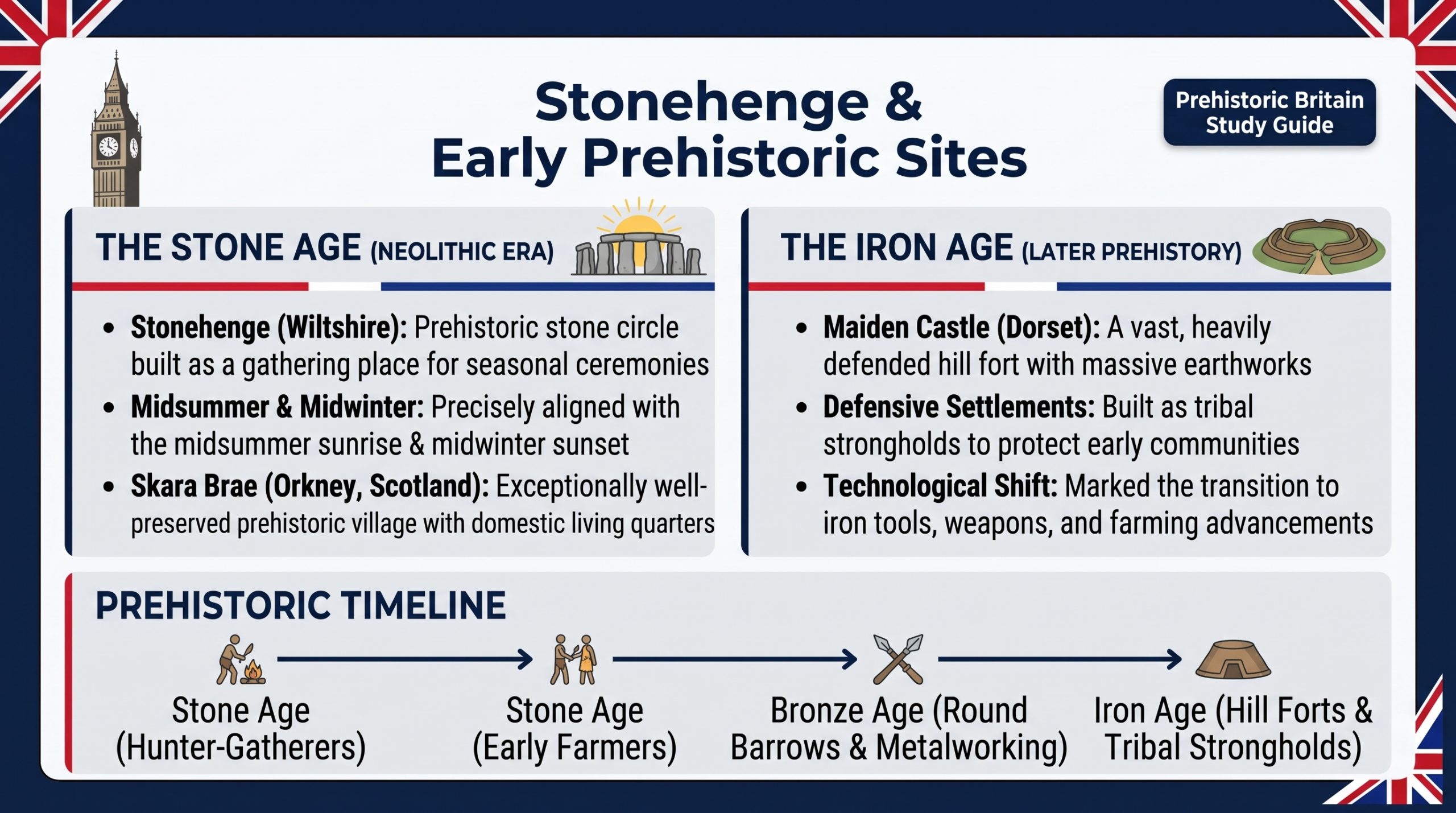
Candidates stumble when Chapter 3 blends different historical eras into back-to-back exam questions. The curriculum spans three prehistoric ages Stone, Bronze, and Iron and each brings its own architectural signature. Stonehenge sits squarely in the Stone Age section, well before anyone smelted bronze weapons or built sprawling Iron Age forts on grassy hills.
You need an 18 out of 24 (75%) to pass. Mixing up ancient sites guarantees lost marks.
The core differences come down to geography and function: Stonehenge in Wiltshire served as a Stone Age ceremonial circle for solar alignments; Skara Brae up on Orkney was a preserved Stone Age village with domestic living quarters; Maiden Castle in Dorset stood as a massive Iron Age hill fort built with defensive earthworks and ramparts.
| Criteria / Aspect | Stonehenge (Wiltshire) | Skara Brae (Orkney) | Maiden Castle (Dorset) |
|---|---|---|---|
| Historical Period | Stone Age (Neolithic) | Stone Age (Neolithic) | Iron Age |
| Site Type | Prehistoric Stone Circle | Preserved Stone Village | Hill Fort |
| Primary Function | Seasonal ceremonies & solar alignment | Domestic habitations & living quarters | Defensive settlement & tribal stronghold |
| Key Feature | Midsummer sunrise / midwinter sunset alignment | Best-preserved prehistoric village in northern Europe | Extensive earthworks and defensive ramparts |
Keep these distinctions clear and the examiner’s trick options won’t phase you.
4. 2026 Interactive Exam Practice Drill
Here are 5 realistic practice questions crafted around official Home Office testing patterns. Work through them, check your answers, and read the rationales carefully so you’re ready for the real thing.
Question 1: In which English county is the prehistoric monument of Stonehenge located?
View Correct Answer & Rationale
Correct Answer: B) Wiltshire
Official Rationale: According to Chapter 3 of the official Home Office handbook, Stonehenge is located in the county of Wiltshire, England. Dorset is associated with Maiden Castle (an Iron Age hill fort), while Cornwall and Yorkshire host other historical landmarks not tied to this specific Stone Age monument answer.
Question 2: According to the official handbook, during which historical period was Stonehenge built?
View Correct Answer & Rationale
Correct Answer: A) The Stone Age
Official Rationale: The Home Office handbook explicitly places the construction of stone circles like Stonehenge in the Stone Age period. While activity continued into later eras, the building of these monuments is tested as a key achievement of Stone Age Britain.
Question 3: What specific solar event is Stonehenge aligned with on the longest day of the year?
View Correct Answer & Rationale
Correct Answer: B) The midsummer sunrise
Official Rationale: The handbook states that Stonehenge was aligned with the rising sun on the midsummer sunrise (the longest day of the year) and the setting sun at the midwinter sunset (the shortest day of the year). Option A flips the event to sunset, which is incorrect for midsummer.
Question 4: Which of the following best describes the primary purpose of Stonehenge as stated in the Life in the UK test handbook?
View Correct Answer & Rationale
Correct Answer: C) A gathering place for seasonal ceremonies
Official Rationale: The official text states that monuments like Stonehenge were special places gathered at for seasonal ceremonies. Defensive fortresses came later (Iron Age hill forts), Anglo-Saxon kings ruled thousands of years later, and it was not a maritime trading port.
Question 5: Which prehistoric site in Scotland is described in the handbook as a well-preserved Stone Age village, often tested alongside Stonehenge?
View Correct Answer & Rationale
Correct Answer: B) Skara Brae
Official Rationale: Skara Brae, located on Orkney off the north coast of Scotland, is the famous Stone Age village cited in the handbook. Maiden Castle is an Iron Age hill fort, Sutton Hoo is an Anglo-Saxon burial site, and Offa’s Dyke is an Anglo-Saxon earthwork on the Welsh border.
Speed builds confidence. Keep hammering practice questions until these choices become second nature.