
Skara Brae Orkney Scotland : Key Differences & Test Traps for Life in the UK Exam
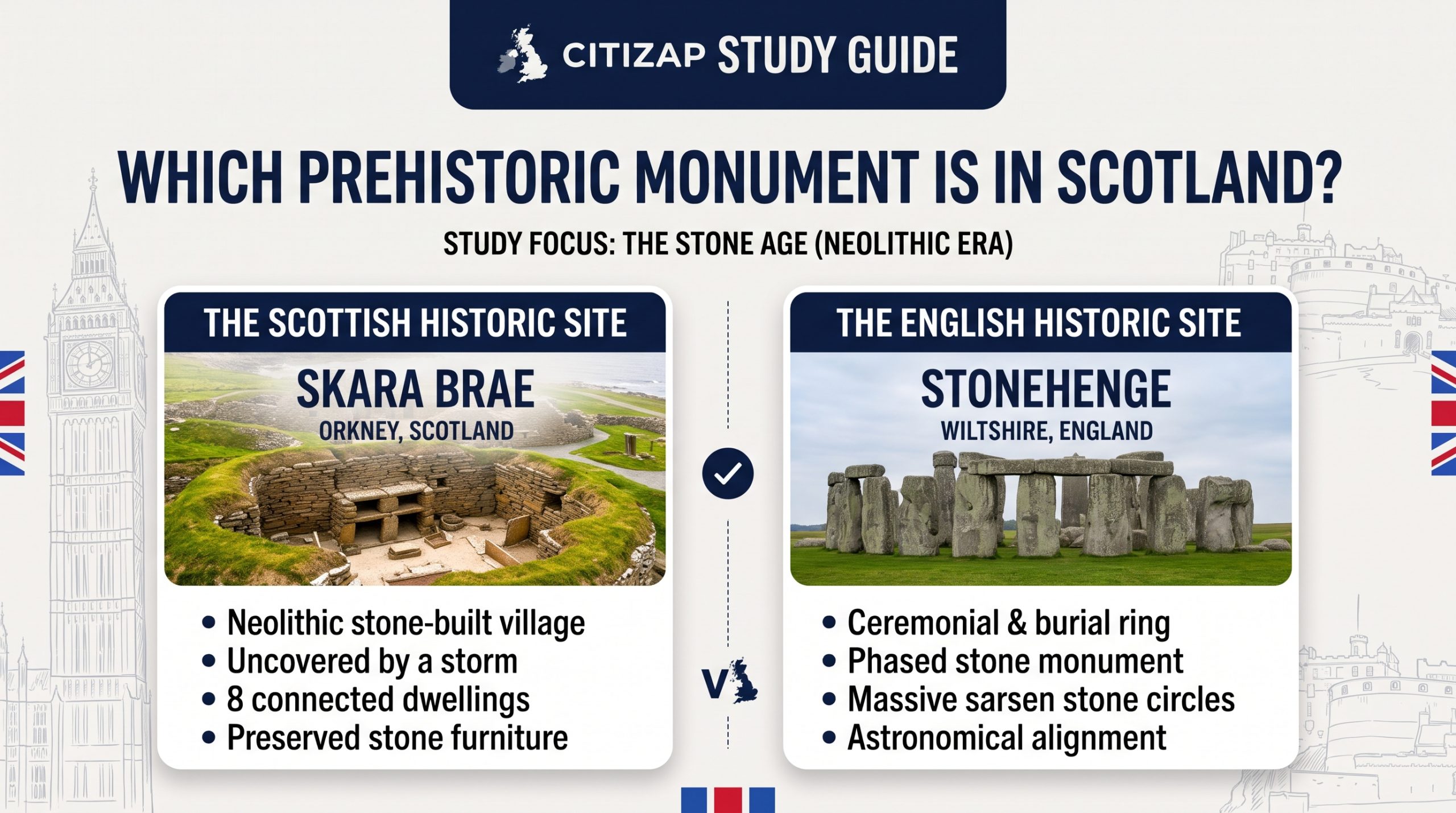
Skara Brae is the exact answer you need. Perched on Orkney’s main island, this Stone Age settlement predates both the Egyptian Pyramids and Stonehenge, serving as the official handbook’s primary Scottish Neolithic reference. You’ll fail this question instantly if you mix it up with English sites like Stonehenge or Avebury.
1. Prehistoric Landmarks: Fast Facts & Core Essentials
Chapter 3 of “Life in the United Kingdom: A Guide for New Residents” (3rd Edition) opens with early human history. It traces how Britain transitioned across the Stone, Bronze, and Iron Ages. You don’t need a degree in archaeology—you just need to match specific landmarks to their home nations without falling for geographic tricks.
| Prehistoric Monument | Location & Region | Historical Era & Purpose | Common Official Test Trap |
|---|---|---|---|
| Skara Brae | Orkney Islands, Scotland | Neolithic Stone Age Village (c. 3000 BC) | Confusing its location with England or misidentifying it as an Iron Age hillfort. |
| Stonehenge | Wiltshire, England | Neolithic / Bronze Age Ceremonial Ring | Assuming Stonehenge is in Scotland or classifying it as a residential village. |
| Maiden Castle | Dorset, England | Iron Age Hill Fort | Confusing Iron Age defensive earthworks with Stone Age domestic settlements. |
| Grime’s Graves | Norfolk, England | Neolithic Flint Mine | Misinterpreting mining shafts as burial mounds or military structures. |
Home Office questions target regional identity. They’ll ask you to group sites by nation (Scotland, England, Wales, Northern Ireland) or by function—like picking out a living space versus a ritual circle.
2. What Chapter 3 Actually Expects You to Know
Ancient Britons lived as nomadic hunter-gatherers until agriculture took root between 4,000 and 2,000 BC. That shift changed everything. Farming meant permanent roots, which led directly to durable stone shelters and massive communal ritual grounds across the British Isles.
Then came a massive storm in 1850. Strip away centuries of sand dunes along Orkney’s Bay of Skaill, and suddenly Northern Europe’s best-preserved Neolithic village sits exposed to the modern world. Eight stone houses emerge, linked together by low, covered alleyways. Since trees were non-existent on the wind-swept island, residents built everything out of local flagstone—cupboards, hearths, dressers, and even stone beds. Historic Environment Scotland records confirm families lived in Skara Brae for roughly six centuries, roughly between 3180 BC and 2500 BC.
Skara Brae isn’t the only landmark on the official syllabus. Down in Wiltshire, England, Stonehenge stands as Britain’s most famous ceremonial ring, built over generations for burials and astronomical tracking. Back up north, the Ring of Brodgar joins Skara Brae, Maeshowe, and the Stones of Stenness to form the UNESCO “Heart of Neolithic Orkney” World Heritage site.
Local geography forced different architectural choices. Southern Britons dug earthworks and hauled giant sarsen stones, but Orkney’s settlers leveraged flat flagstone to construct sheltered homes partially underground. As recorded by the National Archives, these farming communities laid the foundation for the Celtic Iron Age that followed.
3. Spotting the Differences: Scotland vs. England
Candidates miss points when they rush. It’s easy to swap Scottish domestic sites with English stone circles or Anglo-Saxon ship burials if you aren’t paying attention.
| Feature / Attribute | Skara Brae (Scotland) | Stonehenge (England) |
|---|---|---|
| Primary Function | Residential Stone Age Village (8 domestic houses) | Ceremonial & Astronomical Stone Circle / Burial Site |
| Geographic Location | Orkney Islands, Off Northern Coast of Scotland | Wiltshire, South West England |
| Estimated Construction | c. 3180 BC – 2500 BC (Predates Pyramids) | c. 3000 BC – 1600 BC (Phased Construction) |
| Key Architectural Feature | Flagstone furniture, hearths, built-in beds & drains | Massive vertical sarsen stones with horizontal lintels |
| Handbook Classification | Prehistoric Monument in Scotland | Prehistoric Monument in England |
Function matters. Skara Brae served as an actual village. Stonehenge functioned as a monumental circle. Remember that core distinction, and you’ll throw out half the wrong options immediately.
4. 2026 Practice Questions: Test Your Recall
Try these five multiple-choice questions modeled on current Home Office test papers. Pick your option before expanding the explanation box below.
Question 1: Which well-preserved prehistoric village is located in Scotland?
View Correct Answer & Rationale
Correct Answer: B
Official Rationale: Chapter 3 specifies that Skara Brae is an extraordinarily well-preserved Stone Age village situated on Scotland’s Orkney Islands. Stonehenge (Option A) and Maiden Castle (Option C) are English prehistoric sites. Sutton Hoo (Option D) is an Anglo-Saxon burial mound in Suffolk, England.
Question 2: In which region of the UK is the prehistoric monument Skara Brae located?
View Correct Answer & Rationale
Correct Answer: C
Official Rationale: Skara Brae sits in the Orkney Islands off Scotland’s northern coast. The test routinely evaluates your knowledge of geographical locations across all four nations.
Question 3: Skara Brae dates back to which historical period?
View Correct Answer & Rationale
Correct Answer: A
Official Rationale: Built around 3000 BC during the Neolithic period (New Stone Age), Skara Brae was constructed thousands of years before Romans arrived on British shores.
Question 4: Which of the following statements about Skara Brae is TRUE?
View Correct Answer & Rationale
Correct Answer: B
Official Rationale: Skara Brae features stone dwellings filled with built-in stone furniture, including beds, dressers, and central hearths. Stone Age farmers constructed it centuries before Romans or Normans existed.
Question 5: Stonehenge, a famous prehistoric monument, is located in which home nation?
View Correct Answer & Rationale
Correct Answer: D
Official Rationale: Skara Brae is Scotland’s primary prehistoric settlement, but Stonehenge sits in Wiltshire, England. You must know which country holds each monument.
Drill these points until they become second nature. You won’t hesitate when these options pop up during your real exam.