
Round Barrows vs Long Barrows: Prehistoric Burial Mounds Questions Decoded
A classic tripwire on the official Home Office Life in the United Kingdom test isn’t legal theory it’s British prehistory. Specifically, the test loves probing the exact gap between Neolithic Long Barrows and Bronze Age Round Barrows. Get these mixed up, and you risk throwing away easy marks on exam day. Here’s the core rule to lock into memory: Neolithic tribes stacked elongated collective earthworks around 4000–3000 BC, whereas incoming Bronze Age societies introduced circular, individual graves starting near 2200 BC. Master these details, spot the distractors, and clear the prehistory items without breaking a sweat.
1. Prehistoric Burial Mounds Fast Facts & Summary
Tracking the shift from stone tools to metallurgy isn’t just an exercise in history it’s explicit test material. Chapter 3 (“A Long and Illustrious History”) highlights two distinct earthwork styles: Stone Age Long Barrows and Bronze Age Round Barrows. Candidates regularly mix these up on test day.
Memory shortcut: link “Long” with “Neolithic/Stone Age Communal” and “Round” with “Bronze Age Individual.”
| Key Metric / Legal Entity | Official Handbook Rule | Common Exam Trap |
|---|---|---|
| Long Barrows | Constructed during the Neolithic period (New Stone Age) for communal/collective human burials. | Mistakenly selecting Bronze Age or assuming they were built for single individuals. |
| Round Barrows | Introduced during the Bronze Age (~2200 BC) as circular mounds housing single or high-status individual graves. | Confusing Round Barrows with Iron Age hill forts or Stone Age monuments. |
| Associated Metallurgy | Bronze Age settlers crafted weapons, tools, and decorative ornaments from bronze, gold, and copper. | Believing Bronze Age people only worked with stone tools or possessed iron smelting technology. |
| Beaker Culture Artefacts | Round Barrows often contain distinctive pottery vessels (beakers), metal daggers, and personal ornaments. | Assuming clay pottery was absent in pre-Roman Britain or exclusive to the Iron Age. |
That single pair-association resolves nearly every burial mound item you’ll run into on the actual paper.
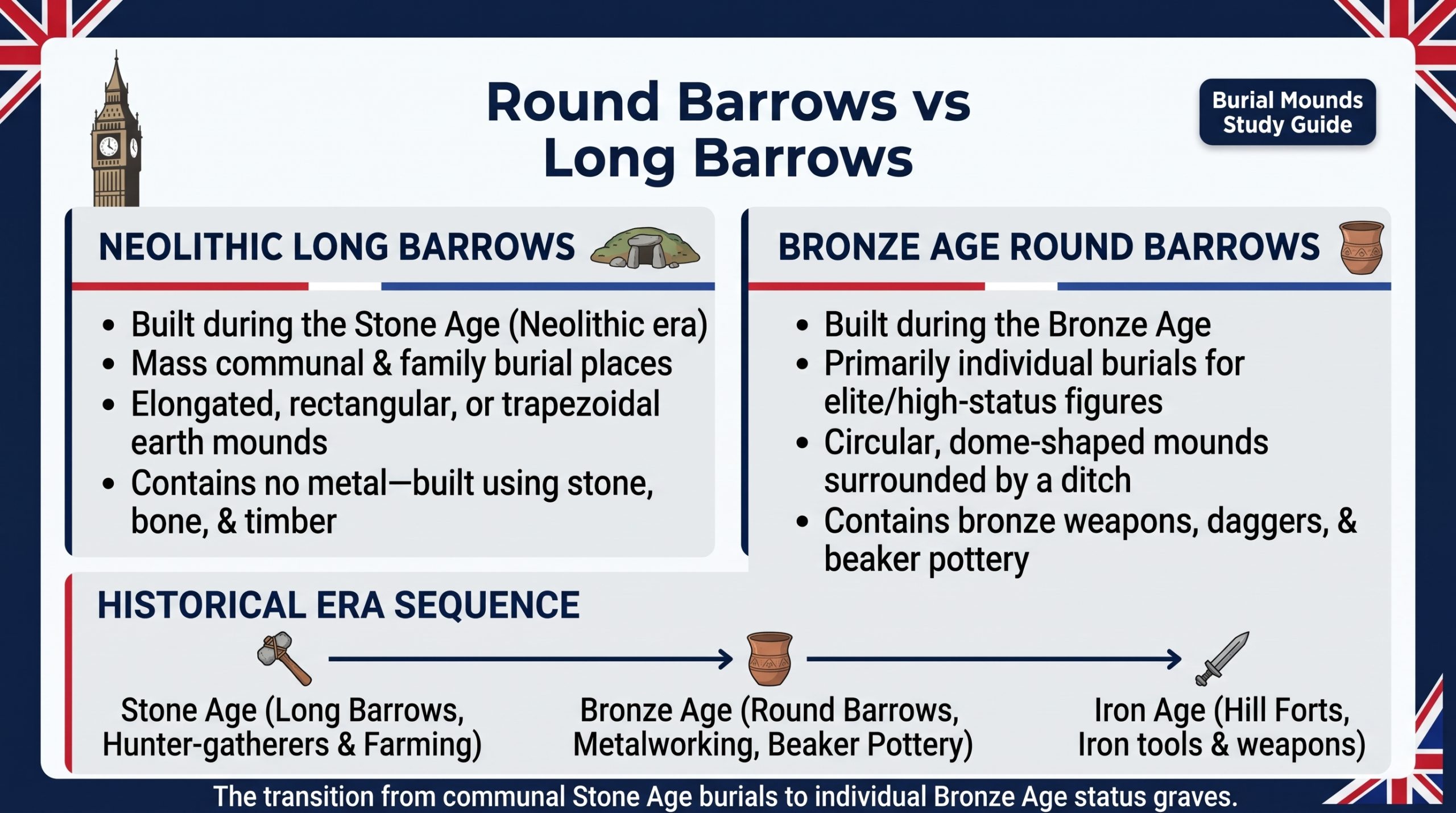
2. Official 3rd Edition Handbook Historical Context
Ancient Britain changed dramatically as farming communities took root roughly 4,000 years ago. Wandering hunter-gatherers gave way to settled cereal farming and cattle rearing across areas like Salisbury Plain and the Scottish highlands. To honor dead elders and anchor claims to land, Neolithic farmers dragged timber and piled thousands of tons of topsoil into massive rectangular or trapezoidal mounds what we call Long Barrows. Digs archived at The British Museum show these functioned as communal family vaults, storing skeletal remains alongside crude flint scrapers across multiple generations.
Then, around 2200 BC, copper and tin smelting arrived. Blending those two metals yielded bronze a game-changer for farming tools, daggers, and prestige gear. Funerary traditions flipped. Instead of communal pits, Bronze Age people raised dome-shaped, circular earthworks Round Barrows over individual graves.
Walk around Stonehenge or Avebury today sites cared for by English Heritage and you’ll spot these mounds dotting the skyline. Inside, archaeologists routinely uncover wealthy grave goods: bronze daggers, stone wrist-guards, gold neck torcs, and distinctive beaker pottery. It’s clear proof of a shifting society led by local warrior chieftains rather than purely egalitarian clan groups.
3. Long Barrows vs Round Barrows Comparative Analysis
Test writers rely on subtle phrasing tricks to trip up candidates who only skimmed the material. When you contrast the physical design, timelines, and social purpose side by side, those distractors fall apart fast.
| Criteria / Aspect | Neolithic Long Barrows | Bronze Age Round Barrows |
|---|---|---|
| Historical Period | Neolithic (New Stone Age), approx. 4000–2500 BC | Bronze Age, starting approx. 2200 BC |
| Physical Shape | Elongated, rectangular, or trapezoidal earth mounds | Circular, dome-shaped mounds often surrounded by a ditch |
| Burial Capacity | Communal/Collective (multiple individuals & families) | Individual burials (single prominent figures or leaders) |
| Associated Metals | None (Stone Age population used flint, bone, & timber) | Bronze, copper, and decorative gold ornaments |
| Key Archaeological Artifacts | Flint scrapers, coarse pottery, animal bones | Beaker pottery, bronze daggers, gold neck torcs |
| Societal Focus | Egalitarian ancestral continuity | Hierarchical status, personal wealth, individual leadership |
Notice the trend. Metalworking created personal status, which reshaped how ancient communities buried their dead. Recognizing that Round Barrows equal individual Bronze Age burials keeps you safe from simple traps.
4. 2026 Interactive Exam Practice Drill
Work through these official-style practice questions to test your recall. Select your option, then pop open the rationale tab to review the exact handbook logic.
Question 1: During which historical period were Round Barrows first constructed in Britain?
- [ ] A. The Iron Age
- [ ] B. The Bronze Age
- [ ] C. The Palaeolithic Period
- [ ] D. The Roman Era
Click to View Answer & Detailed Explanation
Correct Answer: B (The Bronze Age)
Official Handbook Rationale: Around 2200 BC, people in Britain learned to make bronze. During this Bronze Age, people buried their dead in circular earth mounds known as Round Barrows. Iron Age populations constructed hill forts, whereas earlier Stone Age societies built Long Barrows.
Question 2: What was the primary difference between Neolithic Long Barrows and Bronze Age Round Barrows?
- [ ] A. Long Barrows were made of solid bronze, whereas Round Barrows were built from stone
- [ ] B. Long Barrows were used for single graves, while Round Barrows were built for thousands of people
- [ ] C. Long Barrows were communal burial places built in the Stone Age, whereas Round Barrows were individual Bronze Age mounds
- [ ] D. Round Barrows were built by the Romans, whereas Long Barrows were built by the Anglo-Saxons
Click to View Answer & Detailed Explanation
Correct Answer: C (Long Barrows were communal burial places built in the Stone Age, whereas Round Barrows were individual Bronze Age mounds)
Official Handbook Rationale: The official handbook specifically contrasts Neolithic Long Barrows (collective burials for Stone Age communities) with Bronze Age Round Barrows (circular earthworks constructed over individual graves).
Question 3: Is the following statement True or False? “People living in the Bronze Age buried their dead in collective mounds called Long Barrows.”
- [ ] True
- [ ] False
Click to View Answer & Detailed Explanation
Correct Answer: False
Official Handbook Rationale: This statement is completely false. Bronze Age people buried their dead in Round Barrows. Long Barrows were built much earlier by Stone Age (Neolithic) farmers.
Question 4: Which metal alloy was first crafted in Britain around 2200 BC, leading to new cultural traditions like Round Barrow construction?
- [ ] A. Steel
- [ ] B. Iron
- [ ] C. Bronze
- [ ] D. Titanium
Click to View Answer & Detailed Explanation
Correct Answer: C (Bronze)
Official Handbook Rationale: Around 4,000 years ago (~2200 BC), ancient British residents discovered how to make bronze by combining copper and tin, marking the start of the Bronze Age in Britain.
Hit a clean sweep on these? You’re ready for whatever prehistory questions pop up on test day.