Prehistoric Monuments Trick Questions : Key Differences & Test Traps for Life in the UK Exam
Candidates walking into the Life in the UK Test frequently stumble over the prehistoric section. Why? The examiners deliberately swap subtle details, shuffle dates, and scramble geographic locations across early British history. If you can’t tell Stonehenge from Maiden Castle under pressure, you’re handing away easy points. This guide slices through all ten common distractors in the 3rd Edition Handbook syllabus so you walk out with a pass.
1. What the Prehistoric Syllabus Actually Tests
Chapter 3 splits ancient Britain into three distinct ages: Stone, Bronze, and Iron. Missing a single location or mixing up an era will cost you marks on the 24-question test.
Memory slips happen fast.
| Key Metric / Legal Entity | Official Handbook Rule | Common Exam Trap |
|---|---|---|
| Stonehenge | Located in Wiltshire, England; built during the Stone Age and expanded in the Bronze Age. | Confusing its location with Salisbury Plain in Scotland or misattributing it to the Iron Age Celts. |
| Skara Brae | Neolithic village on Orkney, off the north coast of Scotland; best-preserved prehistoric village in northern Europe. | Mistaking Skara Brae for an Iron Age hill fort or placing it in England or Wales. |
| Maiden Castle | Iron Age hill fort located in Dorset, England; represented large defended settlement sites. | Confusing Maiden Castle with Stone Age ceremonial sites or mistaking it for a burial mound. |
| First Farmers | Arrived approximately 6,000 years ago (4000 BC); built monument sites and cleared forests. | Conflating the arrival of agriculture with the arrival of the Celts or the Romans. |
| Bronze Age Metals | People learned to make bronze by mixing copper and tin approximately 4,000 years ago. | Assuming bronze was imported from mainland Europe rather than produced locally from tin and copper. |
Lock these dates down now—it makes navigating the trickier historical nuances much smoother.
2. Dissecting the 3rd Edition Timeline
Ten thousand years ago, rising seas cut off the British Isles from mainland Europe, trapping early hunter-gatherers on an isolated island archipelago where they trailed seasonal game and built temporary shelters across shifting landscapes.
Everything changed around 4000 BC—roughly 6,000 years ago—when agriculture took root. These early farmers stopped wandering. They cleared dense woodland, grew crops, built permanent homes, and raised megalithic monuments that still boggle modern engineers. Stonehenge in Wiltshire stands out as the big one, constructed across centuries from a simple earth ditch into a massive standing stone ring. Up on Orkney off Scotland’s northern tip, sandstorms preserved Skara Brae—a Neolithic village complete with stone beds, hearths, and dressers intact. Check English Heritage for deeper archaeological context on these sites.
By 2000 BC—4,000 years ago—metalworking arrived. Local smiths discovered that blending copper with tin forged bronze, a tough alloy that revolutionized farming tools, weapons, and trade networks stretching across Western Europe. People buried their dead in round barrows with pottery and grave goods, hinting at early religious beliefs.
Then came iron around 800 BC. Iron tools boosted crop yields, driving a massive population surge among the Celts. As competition for fertile land turned fierce, tribes built defended hill forts surrounded by massive earth ramparts—with Maiden Castle in Dorset serving as the handbook’s prime example. You can dig into these excavation records through the Council for British Archaeology.
Pay close attention here: questions on the Iron Age almost always focus on Celtic culture, hill fort defences, and the eventual arrival of written records when Roman legions invaded.
3. Spotting the Examiner’s Traps
Most failed questions don’t happen because candidates didn’t study—they happen because two options sounded almost identical during a split-second decision.
The Home Office relies on this confusion. They’ll pair real monument names with fake eras or wrong countries to see who actually knows the material.
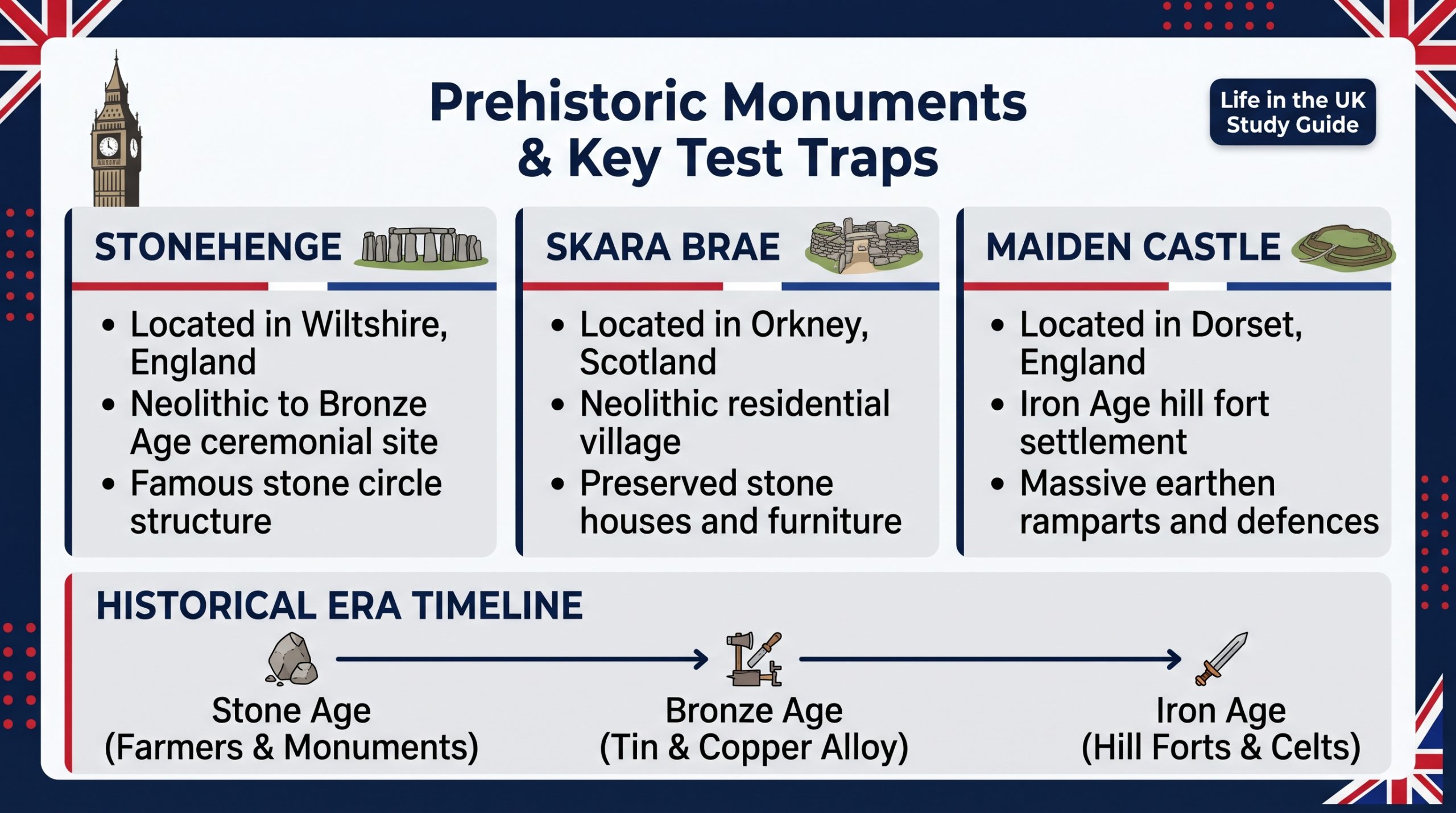
Take Stonehenge, Skara Brae, and Maiden Castle. Stonehenge and Skara Brae both date back to the Stone Age, yet one served as a sacred gathering place in southern England while the other was a coastal living space in northern Scotland. Maiden Castle sits in a completely different category altogether, built thousands of years later as a fortified Iron Age settlement.
| Criteria / Aspect | Stonehenge | Skara Brae | Maiden Castle |
|---|---|---|---|
| Historical Period | Neolithic (Stone Age) to Bronze Age | Neolithic (Stone Age) | Iron Age |
| Location | Wiltshire, England | Orkney, Scotland | Dorset, England |
| Primary Function | Ceremonial & Astronomical Site | Residential Village | Defended Settlement / Hill Fort |
| Key Feature | Standing stone circle structure | Preserved stone houses & furniture | Earthen ramparts & fortifications |
| Frequent Test Trap | Claimed as built by Iron Age Druids | Placed in Wales or England | Described as a Stone Age burial mound |
Memorize these pairs—matching the landmark to its era and location eliminates half the wrong choices instantly.
4. Put Your Knowledge to the Test
Ready to see where you stand? Work through these five practice questions modeled directly after the official 2026 examination format.
Don’t rush. Select your answer first, then open the rationale box below to verify your logic.
Question 1: Where is the prehistoric Neolithic village of Skara Brae located?
View Correct Answer & Rationale
Correct Answer: B
Official Rationale: According to Chapter 3 of the official 3rd Edition Handbook, Skara Brae is a prehistoric village located on Orkney, off the north coast of Scotland. Option A refers to the general region of Stonehenge in Wiltshire. Option C refers to the location of Maiden Castle in Dorset. Option D is an incorrect geographical distractor.
Question 2: Which metal was combined with copper approximately 4,000 years ago to create bronze in early Britain?
View Correct Answer & Rationale
Correct Answer: C
Official Rationale: The official handbook specifies that approximately 4,000 years ago, people in Britain learned to make bronze by mixing copper with tin. Iron (Option A) was used later during the Iron Age, starting around 800 BC. Lead and Zinc (Options B and D) are incorrect metals not featured in this context within the official syllabus.
Question 3: What type of site is Maiden Castle, located in Dorset?
View Correct Answer & Rationale
Correct Answer: B
Official Rationale: Maiden Castle in Dorset is specifically highlighted in the 3rd Edition Handbook as an outstanding example of an Iron Age hill fort. It was a defended settlement surrounded by impressive earth ramparts. It is not a burial mound, stone circle, or Roman structure.
Question 4: Approximately how many years ago did the first farmers arrive in Britain?
View Correct Answer & Rationale
Correct Answer: B
Official Rationale: The handbook states that the first farmers arrived in Britain about 6,000 years ago (around 4000 BC). Option A (10,000 years ago) marks when Britain was separated from the continent by rising sea levels. Option C (4,000 years ago) corresponds to the Bronze Age, while Option D (2,000 years ago) aligns with the Roman invasion.
Question 5: Which prehistoric monument in Wiltshire, England, was built during the Stone Age and stood as a ceremonial site?
View Correct Answer & Rationale
Correct Answer: C
Official Rationale: Stonehenge, located in Wiltshire, England, is a world-famous Stone Age monument described in the handbook as a ceremonial site. Option A is in Scotland. Option B (Offa’s Dyke) was built in Anglo-Saxon times between England and Wales. Option D (Hadrian’s Wall) was constructed by the Romans.
Understanding why wrong answers are wrong is what guarantees a pass on test day.