Prehistoric Monuments Quiz: 15 Common Exam Questions (2027)
Conquering Britain’s ancient history isn’t just about memorizing names—it’s about untangling deep timelines, spotting deliberate test traps, and getting comfortable with the exact layout of modern citizenship exams. This guide rips open the Stone Age and Bronze Age, giving you the facts, architectural quirks, and practical drills needed to blow past that 75% pass mark without breaking a sweat.
1. Forgotten Beginnings: How Farmers Reshaped Ancient Britain
Hundreds of thousands of years before anyone wrote down a single word of history, people lived here. But everything shifted around 4000 BC.
Nomadic hunter-gatherers of the Mesolithic era began settling down, clearing away dense ancient forests to grow wheat and barley while domesticating pigs, cattle, and sheep. Farming changed everything. Once people weren’t constantly moving just to stay alive, they organized massive community work projects. They dug huge earthworks, built stone burial cairns, and raised mysterious ceremonial enclosures that still mark the landscape today.
Then came 2500 BC.
A new wave of people arrived—often called the “Beaker People” because of their distinctively shaped ceramic cups—and brought bronze tools, advanced metalworking, and entirely new ways of burying their dead.
2. Stones, Earth, and Timber: Inside Britain’s Greatest Prehistoric Sites
Standardized exams love testing you on specific places protected by public bodies like English Heritage and Historic Environment Scotland. Knowing where these sites sit, when they were put together, and what they were actually used for isn’t optional if you want a passing score.
Stonehenge (Wiltshire, England)
It’s iconic.
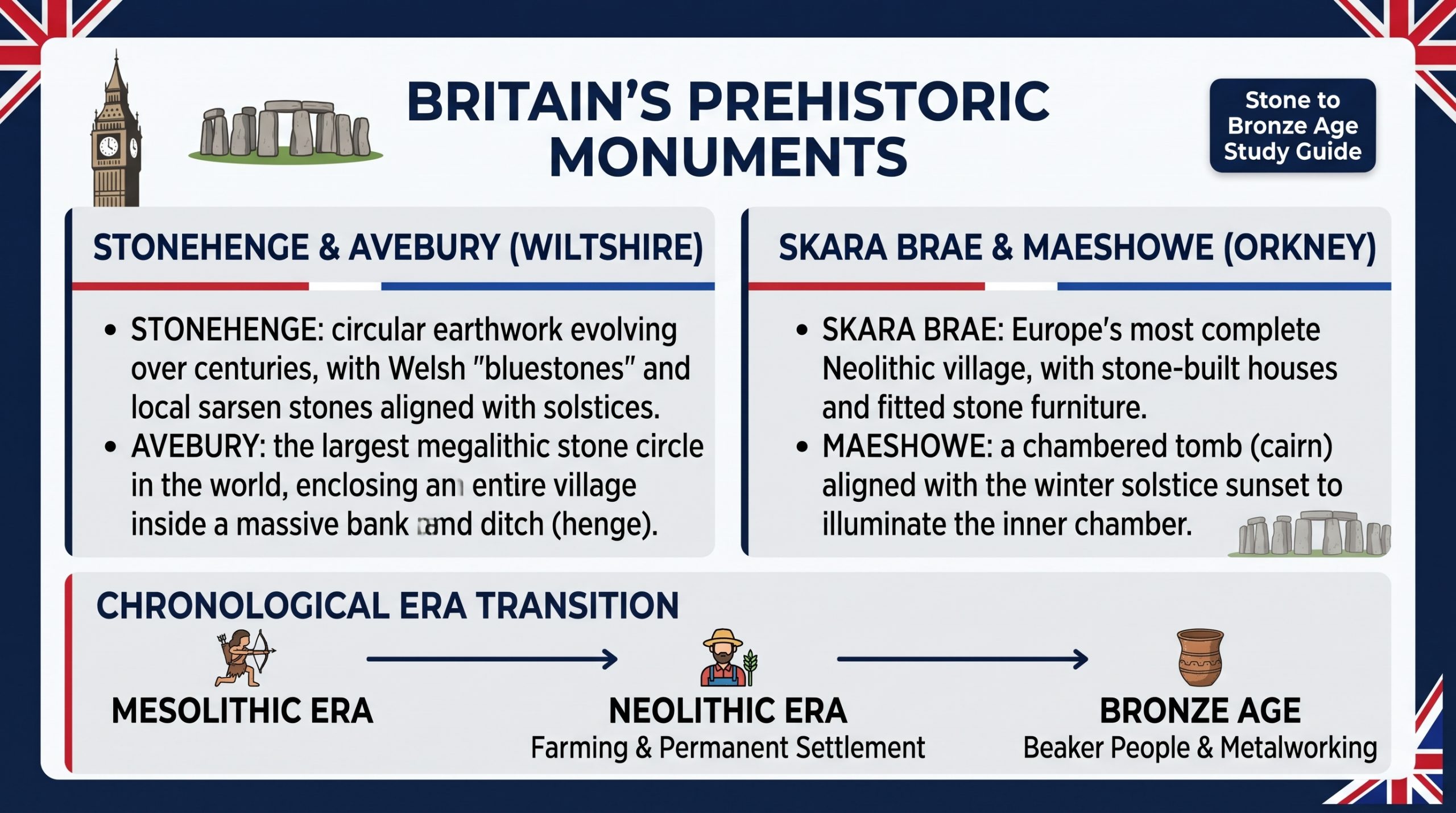
Sitting right in the middle of Salisbury Plain, Stonehenge didn’t just pop up overnight. Builders started around 3000 BC with a simple circular ditch and earth bank. Over 1,500 years, generations kept adding to it. The smaller “bluestones” were dragged over 140 miles from the Preseli Hills in Wales, while the huge sarsen blocks came from the Marlborough Downs nearby. The whole ring lines up directly with the summer and winter solstices, proving these ancient builders kept a remarkably close eye on the skies.
Avebury (Wiltshire, England)
Stonehenge gets the fame, but Avebury is absurdly massive—it’s actually the largest megalithic stone circle anywhere on Earth. Constructed during the Neolithic era, it wraps around an entire modern village and encloses two smaller inner rings. Instead of the shaped stones you see at Stonehenge, Avebury features rough, unhewn boulders set inside a gigantic earth ditch and bank.
Skara Brae (Orkney, Scotland)
A brutal storm in 1850 stripped away sand dunes on Orkney’s mainland, uncovering a hidden treasure: Europe’s most complete Neolithic village. Built between 3180 BC and 2500 BC, these stone houses were linked by covered walkways. Inside, you can still see built-in stone furniture—dressers, storage boxes, hearths, and even stone beds.
| Monument | Location | Primary Era | Key Architectural Feature |
|---|---|---|---|
| Stonehenge | Wiltshire, England | Neolithic to Bronze Age | Lintelled sarsen stones & Welsh bluestones transported over long distances |
| Avebury | Wiltshire, England | Neolithic | World’s largest stone circle |
| Skara Brae | Orkney, Scotland | Neolithic | Subterranean stone houses featuring built-in furniture |
| Maeshowe | Orkney, Scotland | Neolithic | Chambered cairn aligned with winter solstice light |
3. Don’t Fall For These: Classic Exam Traps and Myth-Busting
Getting past that 75% pass mark threshold means dodging the sneaky tricks exam writers hide in multiple-choice options. They love using popular legends that sound true but are completely wrong.
Here’s another odd detail test creators exploit: the word “henge.”
In archaeology, a real henge has a ditch on the inside of its earth bank. Funny enough, Stonehenge’s main ditch sits on the outside—which technically makes Britain’s most famous henge a terrible example of one!
4. Test Your Brain: 15 Practice Questions with Full Explanations
Click through these practice questions to check your knowledge and read detailed rationales for every single answer.
Question 1: In which present-day UK country is the Neolithic village of Skara Brae located?
Correct Answer: Scotland
Rationale: You’ll find Skara Brae right on the Bay of Skaill, situated on the western coast of Mainland—the largest island in Scotland’s Orkney archipelago. It’s officially recognized as a UNESCO World Heritage site.
Question 2: Which group of people were responsible for introducing early bronze metallurgy and distinctive pottery to Britain around 2500 BC?
Correct Answer: The Beaker People
Rationale: Arriving in Britain around 2500 BC, the Beaker culture brought along metalworking skills, bell-shaped clay vessels, and a shift toward individual graves.
Question 3: True or False: The Druids built Stonehenge.
Correct Answer: False
Rationale: Construction spanned from roughly 3000 BC to 1500 BC during the Neolithic and Bronze Ages. Celtic Druids didn’t appear until the Iron Age, long after the work was done.
Question 4: From where were the famous “bluestones” used in the inner ring of Stonehenge transported?
Correct Answer: The Preseli Hills in Southwest Wales
Rationale: Geologists traced these stones directly back to the Preseli Hills in Pembrokeshire, Wales—meaning builders hauled them over 140 miles to reach Salisbury Plain.
Question 5: What type of ancient structure is Avebury in Wiltshire?
Correct Answer: A massive megalithic stone circle and henge
Rationale: Avebury stands as the largest megalithic stone circle in the world, featuring a massive outer henge ditch that encloses two smaller inner circles.
Question 6: What agricultural development marked the beginning of the Neolithic period in Britain around 4000 BC?
Correct Answer: The transition from hunting and gathering to farming and animal domestication
Rationale: The Neolithic era is defined by people giving up the full-time hunter-gatherer lifestyle to cultivate crops and raise livestock in permanent settlements.
Question 7: Maeshowe, a famous Neolithic chambered cairn, is aligned with which astronomical event?
Correct Answer: The Winter Solstice sunset
Rationale: As the sun sets on the winter solstice, its light streams straight down the long entry passage of Maeshowe in Orkney, brightening the central burial chamber inside.
Question 8: What material was primarily used to build the furniture found inside the houses at Skara Brae?
Correct Answer: Stone
Rationale: Timber was scarce on the Orkney Islands, so residents built everything out of local flagstone—including dressers, beds, seats, and storage boxes.
Question 9: What score is typically required to pass standardized UK culture and history tests?
Correct Answer: 75% (18 out of 24 correct answers on official exams)
Rationale: Standard assessments like the official Life in the UK test mandate a score of at least 75% before issuing a passing certificate.
Question 10: Which period immediately followed the Stone Age in British prehistory?
Correct Answer: The Bronze Age
Rationale: Prehistoric timelines in Britain move logically through the Three-Age System: Stone Age (Palaeolithic, Mesolithic, Neolithic), then the Bronze Age, and finally the Iron Age.
Question 11: What is Silbury Hill, located near Avebury in Wiltshire?
Correct Answer: The largest prehistoric man-made mound in Europe
Rationale: Rising roughly 30 meters high, Silbury Hill was piled up during the late Neolithic era. Archaeologists still debate its true purpose.
Question 12: What was the primary purpose of Neolithic long barrows?
Correct Answer: Collective burial places and ancestral tombs
Rationale: Long barrows were rectangular earth mounds constructed over stone or timber chambers, serving as communal tombs during the early-to-middle Neolithic period.
Question 13: Which metal alloy defines the technological advancement of the Bronze Age?
Correct Answer: Copper combined with Tin
Rationale: Bronze is created by mixing copper with tin. Cornwall had vast tin reserves, turning Britain into a vital trading center across prehistoric Europe.
Question 14: What key change in burial practices occurred during the early Bronze Age compared to the Neolithic era?
Correct Answer: A shift from collective burials in long barrows to individual burials under round barrows
Rationale: Instead of large shared tombs, Bronze Age communities began burying individuals on their own beneath circular earth mounds (round barrows), often alongside grave goods like daggers or beaker pottery.
Question 15: Which national heritage body manages Stonehenge on behalf of the British public?
Correct Answer: English Heritage
Rationale: English Heritage operates as a registered charity overseeing more than 400 historic properties and prehistoric monuments across England.
5. Quick Answers to Burning Exam Questions
How can I make sure I lock in that 75% pass mark on exam day?
Focus on cause and effect rather than blindly trying to memorize dates. Know what changed when people started farming, why metalworking shifted society, and how burial styles tell you which era a monument belongs to.
Do questions about ancient monuments pop up often on official tests?
Regularly. Key landmarks like Stonehenge, Avebury, and Skara Brae are standard fixtures in British history sections, so expect questions covering where they sit, who built them, and what makes their architecture unique.