Prehistoric Britain Fast Facts Exam Cheat Sheet: Key Facts for the Life in the UK Test
Chapter 3 moves fast stretching from primitive hunter-gatherers crossing vanished land bridges to tribal warriors building colossal earthen forts. This fast-facts cheat sheet zeroes in on the exact dates, structural landmarks (think Skara Brae and Stonehenge), and subtle test traps the Home Office relies on to throw candidates off balance.
1. Essential Prehistoric Milestones: The Candidate’s Fast-Recall Cheat Sheet
Candidates fail the earliest history modules for one primary reason: confusing architectural sites, technological shifts, and geographical locations. You can’t afford to mix up Neolithic Scotland with Iron Age Dorset when sitting in front of the test terminal.
Memory traps abound throughout Chapter 3. The Home Office explicitly checks whether you know who raised particular monoliths, when basic agriculture took root, and how everyday metalworking evolved across thousands of years.
| Historical Era / Entity | Official Handbook Rule & Key Dates | Common Exam Trap & Distractor |
|---|---|---|
| First Human Inhabitants | Britain joined Europe directly via a physical land bridge until ice melt formed the English Channel roughly 10,000 years ago, forcing early hunter-gatherers to follow wild animal herds on foot. | Mistaking nomadic hunters for settled farmers agriculture didn’t arrive until the Neolithic period (~4,000 BC). |
| Skara Brae (Orkney) | Scotland’s northern Orkney Islands shelter this remarkably preserved Stone Age (Neolithic) village by far Northern Europe’s best-surviving stone settlement. | Classifying Skara Brae under Bronze/Iron Age chapters or placing it inside England or Wales. |
| Stonehenge (Wiltshire) | A iconic prehistoric monument located in Wiltshire, England, whose iconic standing stones were raised across the late Stone Age and early Bronze Age. | Crediting Celts, Druids, or Romans with its construction they arrived centuries later. |
| Bronze Age (c. 2,200 BC) | Metallurgists mixed copper and tin to forge bronze, inaugurating round barrow burials, specialized crafts, and overseas trade networks. | Assuming iron tools preceded bronze bronze technology actually arrived a full millennium earlier. |
| Round Barrows | Distinctive circular earthwork burial mounds where prominent Bronze Age leaders were laid to rest alongside pottery, weapons, and personal ornaments. | Confusing these circular burial mounds with Iron Age hill forts or medieval earthworks. |
| Iron Age (c. 800 BC) | Britons mastered iron smelting for superior weapons and agricultural tools, spoke Celtic tongues, struck early coins, and constructed massive hill forts. | Claiming Romans introduced ironworking the technology flourished in Britain long before Caesar landed. |
| Maiden Castle (Dorset) | Located in Dorset, England, this site remains Britain’s largest, most impressive Iron Age hill fort. | Tagging Maiden Castle as a medieval stone fortress or Norman castle. |
| Celtic Culture & Languages | Iron Age populations spoke Celtic dialects the direct linguistic ancestors of modern Welsh, Irish, and Scottish Gaelic. | Assuming Old English was spoken that language arrived much later with Anglo-Saxon invaders. |
| Early Agriculture | Farming began around 6,000 years ago (c. 4,000 BC) when Neolithic settlers cleared thick forests to grow crops and herd stock. | Attributing agriculture’s arrival to the Bronze Age rather than the early Neolithic transition. |
| Prehistoric Religion | Spiritual life revolved around natural phenomena, seasonal shifts, and ancestral burial rites administered by Celtic priests named Druids. | Conflating pre-Christian Druidic traditions with Roman-era Christian conversion. |
Focus on these core pairings. Knowing them cold stops test writers from tricking you with plausible-sounding wrong answers.
Rising sea levels and technological leaps completely reshaped daily life across the British Isles before recorded history took over.
2. What the Official 3rd Edition Handbook Actually Requires You to Know
The Home Office’s official study guide Life in the United Kingdom: A Guide for New Residents (3rd Edition) frames early British history through distinct technological epochs. Miss these transitions, and you’ll struggle on exam day.
When the last Ice Age receded 10,000 years ago, melting glaciers drowned Doggerland the low-lying land bridge once linking Britain to mainland Europe. The sudden creation of the English Channel left the island isolated. You can double-check current official study requirements through GOV.UK and historical archives at UK Parliament.
Life changed dramatically around 4,000 BC. Nomadic bands stopped wandering. Neolithic farmers cleared dense oak forests, built permanent stone dwellings, and began raising domestic livestock a shift that made monumental projects like stone circles possible.
Around 2,200 BC, everything changed again. Craftsmen realized that blending copper with tin produced bronze a far tougher metal for tools and weapons. Britain’s rich tin reserves in Cornwall instantly turned the island into an important trading hub across Western Europe.
Burial customs shifted alongside metalwork. Long communal tombs vanished. Instead, communities interred elite individuals inside round barrows, packing the earth with bronze blades, gold jewelry, and decorated pottery vessels.
By 800 BC, iron smelting swept across the island. Because iron ore lay everywhere, ordinary farmers gained access to iron-tipped ploughs, heavy axes, and durable weaponry. Populations surged and so did territorial conflict.
Tribes built massive hill forts to protect their grain reserves and livestock. Maiden Castle in Dorset stands as the ultimate example, featuring deep concentric ditches and high earthen ramparts. Society was organized into Celtic tribal groups, with Druid priests serving as judges, religious figures, and keepers of oral history long before Roman legions set foot on British soil.
3. Breaking Down the Eras: Stone vs. Bronze vs. Iron
You’ll almost certainly see test questions comparing prehistoric technologies. Understanding which age introduced specific tools or structures is crucial.
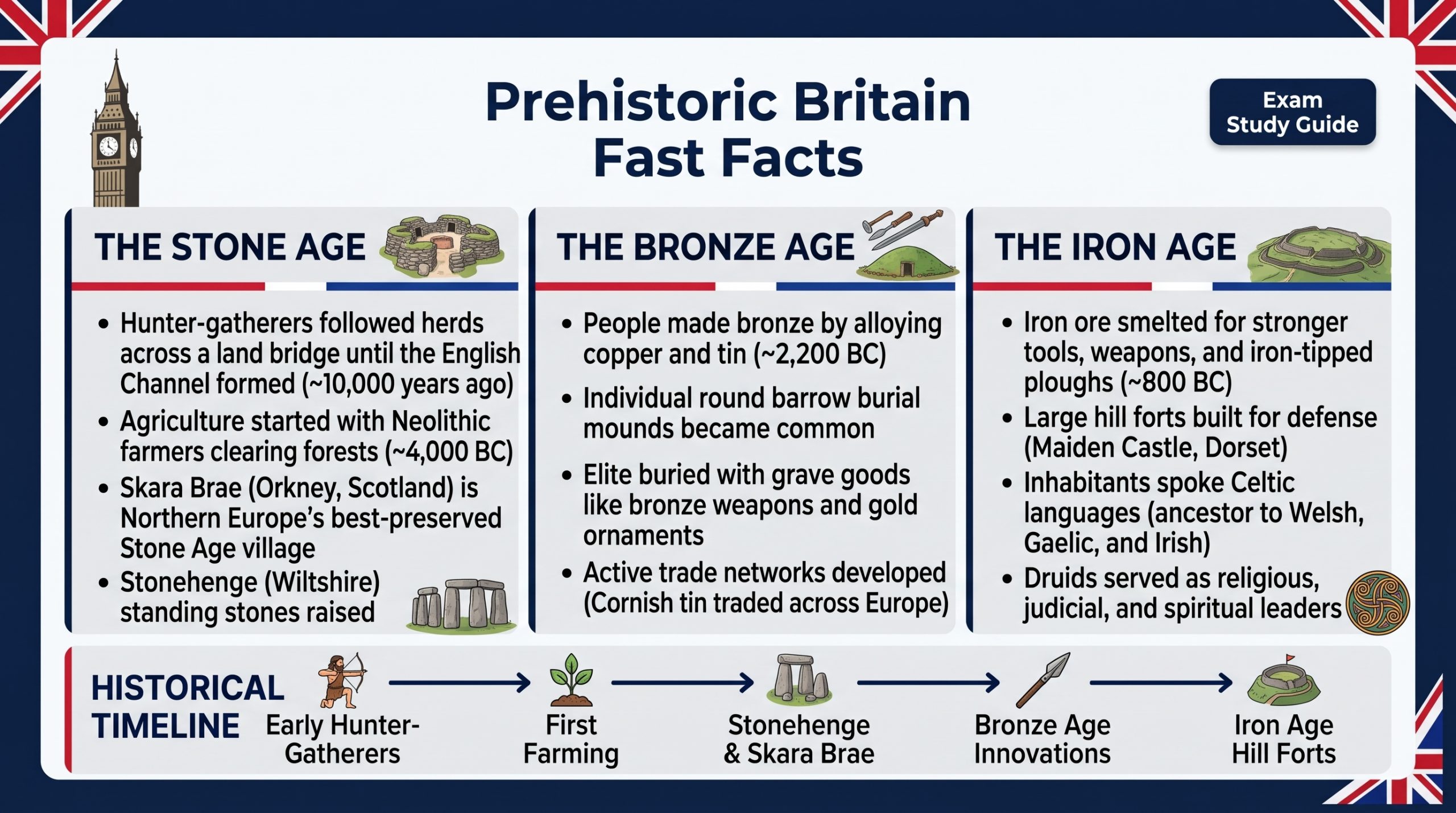
Society didn’t change overnight. The jump from stone tools to fortified Iron Age kingdoms took thousands of years of steady innovation.
| Comparison Criteria | Stone Age (Neolithic) | Bronze Age | Iron Age |
|---|---|---|---|
| Primary Material | Knapped flint, polished stone, animal bone, antler, and timber. | Smelted copper alloyed with tin (bronze), alongside decorative gold. | Refined iron ore forged into heavy tools, weapons, and armor. |
| Key Architectural Feature | Drystone houses (Skara Brae), chambered tombs, early stone circles. | Circular roundhouses, individual round barrow earthworks. | Massive earthwork hill forts (Maiden Castle) with defensive ramparts. |
| Economic & Social Base | Subsistence farming, crop cultivation, small coastal villages. | European maritime trade routes, metal specialization, clear social ranks. | Intensive agriculture, regional trade hubs, minting of tribal coins. |
| Language & Culture | Pre-Indo-European tribal dialects. | Early trade languages across Atlantic networks. | Spoken Celtic languages; spiritual guidance by Druid priests. |
| Famous British Site | Skara Brae (Scotland), early earthworks at Stonehenge. | Stonehenge trilithon standing stones, Bush Barrow (Wiltshire). | Maiden Castle (Dorset), Danebury (Hampshire). |
Notice the patterns. Mention of “iron-tipped ploughs” or “hill forts” automatically points to the Iron Age knapped flint and stone huts point straight to the Stone Age.
Stonehenge itself bridges two eras, starting as a Stone Age earthwork before expanding during the Bronze Age. Keep that overlap in mind when answering trick questions.
4. 2026 Interactive Exam Practice Drill
Test your knowledge with these five authentic practice questions built to match the current Home Office computer-based format. Read each question carefully before checking the answer breakdown.
Working through rationales helps lock in why distractors fail, so you don’t make simple mistakes during the real exam.
Question 1: Where is the remarkably preserved Stone Age village of Skara Brae located?
Click to View Correct Answer & Rationale
Correct Answer: B) Orkney, Scotland
Rationale: Skara Brae sits on the Orkney Islands off Scotland’s northern coast. It’s Europe’s most intact Neolithic village. Dorset hosts Maiden Castle, while Wiltshire is home to Stonehenge don’t let the exam swap these locations on you!
Question 2: Which metal alloy was created during the Bronze Age by combining copper and tin?
Click to View Correct Answer & Rationale
Correct Answer: C) Bronze
Rationale: Around 2,200 BC, craftspeople learned that alloying copper with tin created bronze a discovery that launched the Bronze Age. Iron came much later (c. 800 BC), while steel and brass are irrelevant to this prehistoric syllabus module.
Question 3: What type of historical site is Maiden Castle in Dorset?
Click to View Correct Answer & Rationale
Correct Answer: C) An Iron Age hill fort
Rationale: Maiden Castle is Britain’s largest Iron Age hill fort. Don’t let the word “Castle” fool you it wasn’t built by medieval Normans, but by Iron Age Britons using massive dirt ramparts.
Question 4: Approximately when did Britain become permanently separated from mainland Europe by rising sea levels?
Click to View Correct Answer & Rationale
Correct Answer: B) About 10,000 years ago
Rationale: As the last Ice Age ended roughly 10,000 years ago, melting glaciers flooded Doggerland, forming the English Channel and cutting Britain off from continental Europe.
Question 5: Who were the religious and spiritual leaders of British Celtic society during the Iron Age?
Click to View Correct Answer & Rationale
Correct Answer: A) Druids
Rationale: Iron Age Celts relied on Druid priests for spiritual leadership, legal judgments, and oral traditions. Christian bishops didn’t arrive until Roman times, while medieval barons belonged to a completely different era.
Scoring 5 out of 5? You’re on track. If you missed any, re-read the cheat sheet table above.
Pairing these facts with regular mock testing is the fastest way to lock in a passing score on exam day.