
Prehistoric Britain End Date 55 BC: Life in UK Test Timeline Traps
Everything changed when Julius Caesar’s fleet loomed off the Kentish coast. In the official Home Office handbook, Prehistoric Britain officially ends in 55 BC when Caesar’s reconnaissance force splashed ashore, a single date marking the exact chronological threshold where unrecorded prehistory abruptly gives way to written British history, making 55 BC one of the most lethal date traps on the entire Life in the UK Test.
1. Decoding the 55 BC Cut-Off: Core Facts for Candidates
You can’t skip dates. Chapter 3 (“A Long and Illustrious History”) of the Home Office 3rd Edition handbook sets tight timeline boundaries, and candidate after candidate stumbles by entangling the prehistoric era’s finish line with much later events like Emperor Claudius’s full-scale invasion in AD 43 or the eventual departure of the Roman legions in AD 410. Getting a handle on the exact dividing line between unwritten archaeological ages and verified ink-on-parchment history keeps you from throwing away easy marks on exam day.
It comes down to written records. That’s the entire test key. Before 55 BC, everything we know about human life across the island stems from physical digs: burial mounds, corroded bronze spearheads, pottery, and the silent stones of megalithic monuments. The second Julius Caesar picked up his pen to write Commentarii de Bello Gallico, Britain entered classical literature. That precise moment permanently locked 55 BC as the hard stop for British prehistory in the Home Office syllabus.
| Timeline Event / Marker | Official Handbook Rule | Common Exam Trap |
|---|---|---|
| Prehistoric Britain End Date | Strictly 55 BC (Julius Caesar’s reconnaissance landing). | Confusing 55 BC with the actual conquest in AD 43 under Emperor Claudius. |
| First Written Accounts | Julius Caesar authored detailed eyewitness descriptions of native British tribes and their customs. | Assuming written history didn’t start until the Anglo-Saxons or Normans arrived. |
| Iron Age Cut-Off Boundary | The Iron Age overlaps late prehistory and reaches its formal endpoint with Roman contact in 55 BC. | Believing the Iron Age somehow wrapped up decades before any Romans set foot on the island. |
| Reconnaissance vs. Conquest | Caesar’s initial 55 BC expedition was an armed scouting mission, not a permanent territorial takeover. | Picking “Full Conquest” when the question specifically asks about Caesar’s initial 55 BC landing. |
The Home Office tests exact dates as framed inside the official text. Archaeologists might debate gradual cultural shifts over centuries, but as far as your computer screen at the test centre is concerned, 55 BC operates as a razor-sharp boundary line.
Mixing up Caesar’s brief landings in 55 BC and 54 BC with the real imperial conquest ninety years down the line remains the single biggest reason test-takers drop points on early historical questions.
2. Inside Chapter 3: Why Caesar’s Landing Changed the Rules
Chapter 3 walks through hunter-gatherers, early farmers hauling monoliths for Stonehenge, and Iron Age Celtic tribes forging weapons while trading across the Channel. Yet despite their sophisticated metalwork and massive earthwork forts, these early societies left zero written records. Not a line. Because of that silence, every millennium of human activity prior to the mid-first century BC gets swept under one umbrella: prehistory.
When Caesar waded onto the Kentish beachhead in 55 BC, he brought military legions and the Latin alphabet. He documented Celtic war chariots, tribal politics, religious leaders, and coastal geography, creating Britain’s first written footprint. Anyone wanting to explore these original accounts can inspect historical manuscripts through the British Library or check preserved government records held at The National Archives.
Scouting isn’t occupying.
Caesar fought a few skirmishes, took local hostages, demanded promises of annual tribute, and promptly sailed back to Gaul before winter storms wrecked his ships. He didn’t build roads, he didn’t construct forts, and he left zero army garrisons behind on British soil during these initial visits.
Even without an army of occupation staying behind in 55 BC, the island’s isolation was shattered forever. British chieftains began minting coins stamped with Latin characters, cross-Channel trade exploded, and Roman historians kept writing about British affairs. That continuous paper trail is precisely why 55 BC forms the permanent divide where prehistoric Britain officially closes.
3. Prehistory vs. Recorded History: The Critical Differences
Mastering this section means looking at what changed before and after 55 BC. You aren’t just memorizing a year; you’re tracking how the Home Office contrasts an unlettered tribal society with a documented historical period. Before 55 BC, information depended strictly on physical digs, grave goods, hill fort ditches, and worked flint. Afterward, historians gained access to classical books, personal letters, and carved Latin inscriptions, shifting the entire basis of historical knowledge.
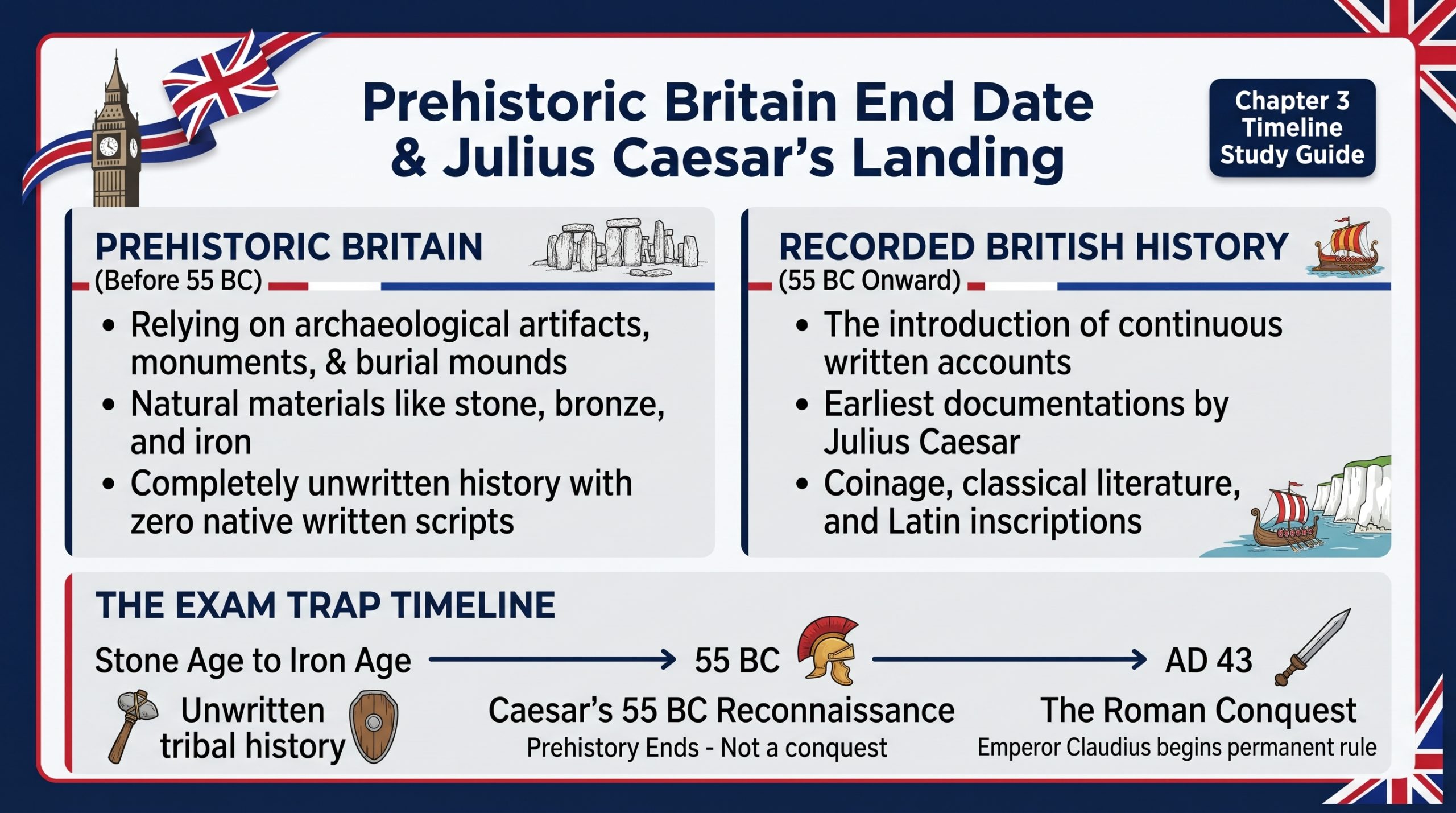
| Historical Criteria | Prehistoric Britain (Before 55 BC) | Recorded British History (55 BC Onward) |
|---|---|---|
| Primary Information Source | Physical artifacts, earthworks like Stonehenge, burial mounds, and forged iron tools. | Written manuscripts, classical texts, Latin stone inscriptions, and minted coins. |
| Key Timeline Marker | Stone Age, Bronze Age, and Celtic Iron Age tribal eras. | Julius Caesar’s 55 BC landing; full imperial conquest in AD 43. |
| Written Communication | No native script; heavy reliance on oral lore and visual symbols. | Latin introduced; permanent written logs kept by Roman officers and historians. |
| Syllabus Classification | Unwritten ancient era prior to Mediterranean contact. | Official starting line for recorded historical events in Chapter 3. |
| Exam Distractor Risk | Confusing Iron Age craft skill with the actual start of written records. | Mashing Caesar’s 55 BC scouting trip together with Claudius’s AD 43 invasion force. |
A lot of candidates make the mistake of thinking Iron Age Celtic culture evaporated the moment Caesar showed up. It didn’t. Tribal kingdoms, Druidic rituals, and roundhouse villages carried on for decades after 55 BC. But for the Life in the UK Test, the presence of Roman pens brings the prehistoric label to a definitive end at 55 BC.
Keep your BC and AD dates straight, and you won’t get caught out. When you see phrases like “first written records,” “Julius Caesar,” or “end of prehistory,” your mind should lock onto 55 BC immediately.
4. 2026 Interactive Exam Practice Drill
Put your knowledge to the test with these mock questions formatted to match the real Home Office test engine. Work through them slowly and make sure to open the rationale boxes to check the reasoning behind each answer.
Question 1: According to the Official 3rd Edition Handbook, in which year did prehistoric Britain officially end with the arrival of Julius Caesar?
View Correct Answer & Rationale
Correct Answer: B) 55 BC
Explanation: Prehistoric Britain officially ended in 55 BC when Julius Caesar led his initial military expedition across the Channel, creating the first written accounts of the island. AD 43 marks the invasion under Emperor Claudius, whereas AD 410 marks the final collapse of Roman rule in Britain.
Question 2: What key historical development marks the end of the prehistoric period in Britain?
View Correct Answer & Rationale
Correct Answer: C) The beginning of continuous written historical records
Explanation: Prehistory literally means the period before written records exist. Julius Caesar’s personal accounts of his 55 BC expedition delivered the earliest surviving written descriptions of British people, signaling the formal shift into recorded history.
Question 3: True or False: Julius Caesar successfully conquered Britain and made it a permanent province of the Roman Empire in 55 BC.
View Correct Answer & Rationale
Correct Answer: B) False
Explanation: Don’t fall for this classic trap. Caesar led a brief reconnaissance mission in 55 BC and returned for another campaign in 54 BC, but he never conquered the island. The actual Roman conquest happened nearly a century later in AD 43 under Emperor Claudius.
Question 4: Which prehistoric era was occurring in Britain immediately before and during Julius Caesar’s arrival in 55 BC?
View Correct Answer & Rationale
Correct Answer: C) Iron Age
Explanation: When Caesar landed in 55 BC, Britain was in the middle of the Iron Age. Celtic populations lived in organized tribal societies, spoke Celtic dialects, crafted iron weapons, and fortified massive hill sites like Maiden Castle.
Drill these until you don’t have to second-guess yourself. Spotting the difference between “first landing,” “full conquest,” and “end of Roman rule” is what separates a pass from a retake.