
Maiden Castle vs Roman Forts : Key Differences & Test Traps for Life in the UK Exam
Mistaking Iron Age hill forts like Maiden Castle for Roman military outposts stands as one of the most persistent distractor traps inside Chapter 3 of the Home Office test. It’s an easy slip both dominate early British history yet Maiden Castle was scraped out of the Dorset chalk by Celtic Britons centuries before Roman legions poured concrete for garrisons like Housesteads along Hadrian’s Wall. Missing that chronological divide costs points. This guide untangles the historical timeline, breaks down the core handbook facts, and dissects real exam question patterns so you don’t fall for the Home Office’s classic distractor tricks on test day.
1. Iron Age Earth vs Roman Stone: What the Examiners Actually Test
Chapter 3 “A Long and Illustrious History” causes endless headaches for applicants who mix up pre-Roman earthworks with classical Roman military engineering. The examiners know this. They deliberately craft questions that bait candidates into labeling Maiden Castle a Roman fortification simply because it’s ancient, complex, and fortified.
They aren’t the same. Not even close.
| Key Metric / Historical Entity | Official Handbook Rule | Common Exam Trap |
|---|---|---|
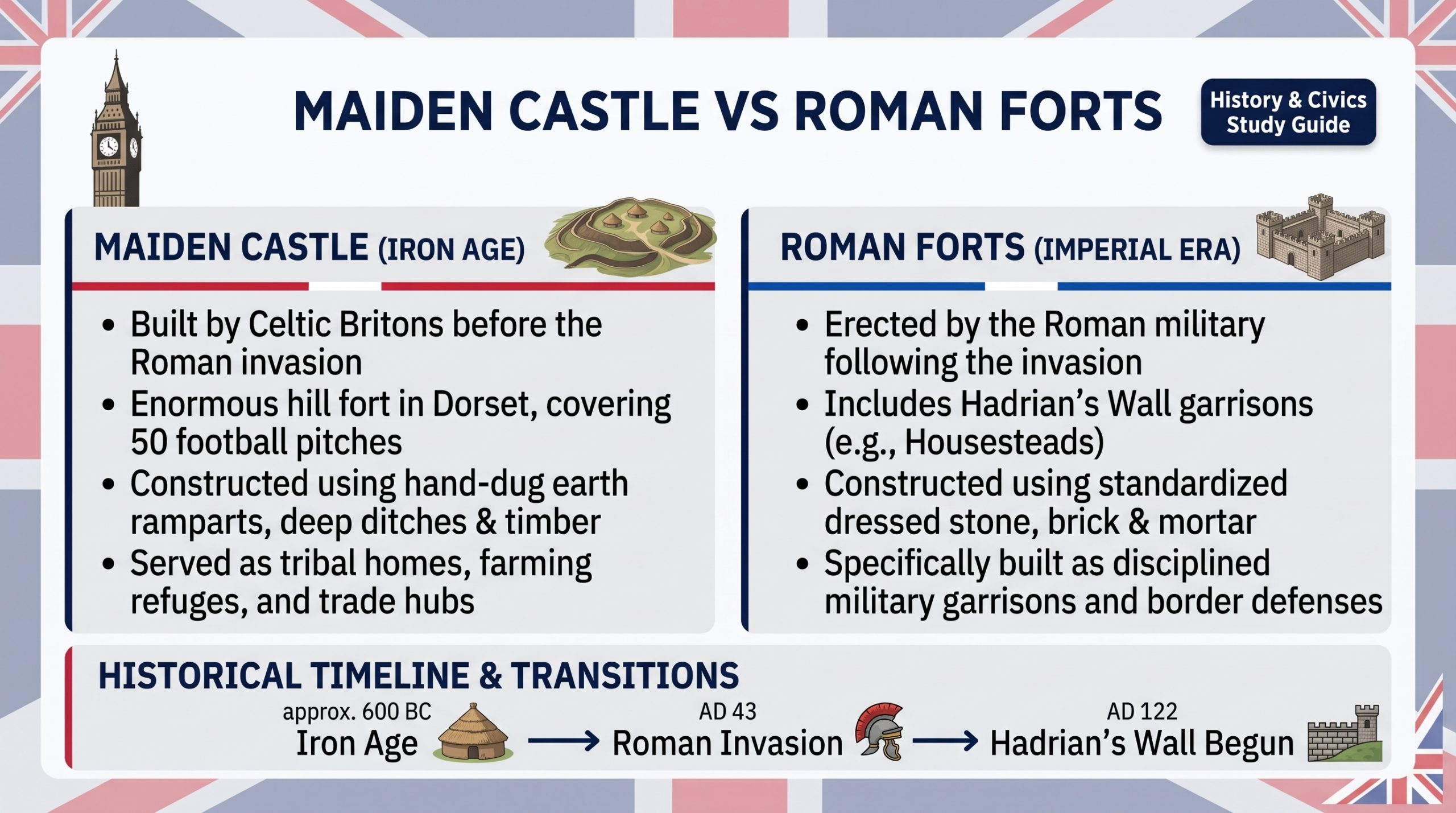
| Maiden Castle (Dorset) | Britain’s largest Iron Age hill fort, constructed by Celtic tribal communities around 600 BC. | Falsely classifying it as a Roman fort or claiming it was constructed during the AD 43 invasion. |
| Iron Age Hill Forts | Earthen ramparts, deep ditches, and timber palisades built for tribal defense and livestock protection. | Confusing massive dirt banks with Roman mortared masonry or the stone garrisons along Hadrian’s Wall. |
| Roman Forts (e.g., Housesteads) | Rectilinear stone garrisons erected after AD 43, including tactical imperial outposts guarding northern frontiers. | Assuming every ancient fortification discovered in Britain belongs to the Roman Empire. |
| Historical Chronology | The Iron Age (c. 600 BC – AD 43) strictly predates the Roman Period (AD 43 – AD 410). | Mashing Celtic pre-Roman achievements together with later Roman provincial engineering. |
Lock that timeline down pre-Roman native earthworks on one side, imperial Roman masonry on the other and you’ll instantly spot the wrong answers on every pre-medieval architecture question on the paper.
2. Inside the Official 3rd Edition Syllabus
The Home Office handbook (Life in the United Kingdom: A Guide for New Residents, 3rd Edition) traces Britain’s structural evolution step-by-step. Around 600 BC, Britain entered the Iron Age. The inhabitants Celtic tribes speaking dialects ancestral to modern Welsh and Gaelic didn’t build sprawling stone cities. Instead, they settled in defensive hilltop enclosures, carving gigantic earthen concentric mounds and ditches out of the landscape to shelter families, hoard grain, and defend livestock against neighboring clans.
Maiden Castle in Dorset represents the pinnacle of this pre-Roman tribal movement. Sprawling across an area equivalent to roughly 50 football pitches, its chalk ramparts dominated the local landscape. While early humans used the site during the Neolithic era, the soaring defensive earthworks candidates get tested on were raised squarely during the Celtic Iron Age. According to archaeological records preserved by English Heritage, these sites operated as economic and ceremonial heartlands for local chieftainships never as imperial Roman outposts.
Everything changed in AD 43. Emperor Claudius dispatched legions across the Channel, launching the successful conquest of Britain and introducing an entirely different approach to military architecture. Roman soldiers didn’t pile up uneven dirt mounds along hill contours; they laid down rigid, standardized rectangular “playing card” grid forts crafted from cut stone and mortar. Complete with administrative headquarters, heated officer quarters, granaries, and paved military roads, these garrisons housed standing imperial legions focused on territorial control rather than tribal farming life.
Location matters on this test, too. When Emperor Hadrian ordered the construction of Hadrian’s Wall in AD 122 to keep out the Picts from Caledonia (modern Scotland), Roman engineers built stone forts like Housesteads (Vercovicium) directly into the wall itself. That was roughly 700 years after Celtic tribes started digging at Maiden Castle. Primary archives hosted on GOV.UK underline this stark divide: native Celtic earthworks belong to prehistory, whereas Roman stone garrisons reflect classic imperial provincial rule.
3. The Side-by-Side Reality Check
Confusion usually spikes because the Romans *did* interact with Maiden Castle Vespasian’s Second Augustan Legion stormed the hill fort during the AD 43 invasion, overwhelming the Celtic defenders. But attacking a site doesn’t make you its builder. The Romans breached the earthworks, forcibly dismantled the settlement, and moved the local population down to their newly founded Roman grid town of Durnovaria (modern Dorchester).
It’s a classic historical overlap that trick questions love to exploit.
| Criteria / Aspect | Iron Age Hill Forts (e.g., Maiden Castle) | Roman Military Forts (e.g., Housesteads) |
|---|---|---|
| Primary Builder | Celtic Britons (Native pre-Roman tribal societies) | Roman Imperial Army (Post-AD 43 invasion forces) |
| Construction Era | Iron Age (c. 600 BC – AD 43) | Roman Britain (AD 43 – AD 410) |
| Primary Materials | Hand-dug earth embankments, timber palisades, chalk ditches | Dressed stone masonry, terracotta tile, mortared walling |
| Structural Shape | Follows natural hilltop contours asymmetrical, sweeping, oval | Standardized rectangular grid strict “playing card” layout |
| Primary Function | Tribal defense, farming refuge, community grain storage | Imperial border defense, legionary garrison, troop staging |
| Handbook Example | Maiden Castle (Dorset) | Housesteads / Hadrian’s Wall Forts |
Keep these structural differences straight and you won’t get caught out when a question mixes up Celtic building materials with Roman legionary bases.
4. Put Your Knowledge to the Test: 2026 Practice Drill
Work through these 5 realistic practice questions formatted to match current Home Office exam criteria. Click each accordion to check your answer and read the full rationale behind the correct choice.
Don’t skim the explanations understanding *why* the wrong choices are wrong is how you beat distractor options on the real test.
Question 1: What type of historical structure is Maiden Castle in Dorset?
View Correct Answer & Rationale
Correct Answer: B) An Iron Age hill fort built by Celtic Britons
Official Rationale: Chapter 3 of the official Home Office 3rd Edition handbook explicitly names Maiden Castle in Dorset as the largest surviving Iron Age hill fort in Britain. Option A is incorrect because Maiden Castle wasn’t built by the Romans. Option C is wrong because it’s a defensive fort rather than a simple burial mound, and Option D is out by more than a thousand years the Normans arrived long after.
Question 2: Which of the following statements about Iron Age hill forts in Britain is TRUE?
View Correct Answer & Rationale
Correct Answer: B) They were built on hilltops with ditches and earth ramparts for tribal defense
Official Rationale: The handbook explains that Iron Age Britons lived in tribal communities defended by hill forts featuring massive earthen mounds and ditches. Option A wrongly assigns stone garrison construction to the Celts. Option C points to the Norman conquest, while Option D confuses local hill forts with the northern border defense of Hadrian’s Wall.
Question 3: In which year did the successful Roman invasion of Britain led by Emperor Claudius begin?
View Correct Answer & Rationale
Correct Answer: C) AD 43
Official Rationale: Emperor Claudius launched the successful Roman conquest of Britain in AD 43. Julius Caesar led earlier, unsuccessful reconnaissance expeditions in 55 BC and 54 BC (Options A and B). AD 122 (Option D) marks the year Emperor Hadrian ordered construction to begin on Hadrian’s Wall.
Question 4: Which ancient Roman fortification was built across the north of England to keep out the Picts?
View Correct Answer & Rationale
Correct Answer: C) Hadrian’s Wall
Official Rationale: Emperor Hadrian ordered his soldiers to construct Hadrian’s Wall across northern England to control movement and keep out the Picts. Option A (Maiden Castle) is an Iron Age hill fort located down in Dorset. Option B (Offa’s Dyke) was dug centuries later by an Anglo-Saxon king along the Welsh border, and Option D (Tower of London) was built by William the Conqueror in the 11th century.
Question 5: Which civilization introduced the first written language, paved roads, and coin minting to Britain during the Iron Age and Roman eras?
View Correct Answer & Rationale
Correct Answer: C) The Romans
Official Rationale: Following their AD 43 invasion, the Romans transformed Britain by introducing written records, a network of paved roads, widespread coinage, and formal legal structures. While late Iron Age tribes had begun minting basic coins through continental trade, it was the Roman administration that standardized these systems across the province.
Run through these questions a few times until the distinction between pre-Roman earthworks and Roman stone forts becomes second nature.