
Maiden Castle Dorset Hill Fort: Iron Age Test Prep & ILR Rules
Getting a handle on the Iron Age section in the Home Office handbook isn’t optional if you’re aiming to clear your citizenship exam on the first try. Take Maiden Castle down in Dorset it’s Europe’s largest Iron Age hill fort, and test writers love pulling questions from this specific slice of history for Indefinite Leave to Remain (ILR) applicants.
1. Maiden Castle Dorset Hill Fort: Core Exam Facts
Chapter 3 “A Long and Illustrious History: Early Britain” makes one thing clear: the Iron Age changed everything across the British Isles. Before Roman soldiers ever set foot on the island in 43 AD, Celtic tribes were building massive hill forts that doubled as fortified strongholds, trading posts, and regional administrative hubs.
Know this cold.
If you’re studying for your ILR test, you can’t afford to confuse Maiden Castle with later medieval stone fortresses or Neolithic monuments. The computer will throw distractor options at you, so memorizing its exact location, classification, and era is a absolute must.
| Key Metric / Legal Entity | Official Handbook Rule | Common Exam Trap |
|---|---|---|
| Monument Name | Maiden Castle | Mistaking it for stone castles built centuries later (like Windsor or Warwick Castle). |
| Location | Dorset, South West England | Guessing Wiltshire that’s where Stonehenge sits, not Maiden Castle. |
| Historical Period | Iron Age (approx. 800 BC – 43 AD) | Selecting the Bronze Age or Roman Britain era by mistake. |
| Historical Significance | One of the largest and most complex Iron Age hill forts in Europe | Assuming it was constructed as a Norman fortification after 1066. |
| ILR / Citizenship Context | Directly referenced in official Home Office Chapter 3 questions | Conflating Iron Age earthworks with Anglo-Saxon burhs. |
Locking down these baseline details gives you an instant advantage when early British history pops up on screen during your 24-question exam.
2. Behind the Syllabus: How the Iron Age Reshaped Britain
Around 800 BC, people across Britain figured out how to smelt iron. That single technological leap rendered soft bronze obsolete almost overnight turning everyday agriculture upside down with tougher iron ploughs while giving tribal leaders far more lethal weaponry. Populations boomed. Trade routes stretched across Atlantic Europe. But as land grew scarce and tribal rivalries turned bloody, communities started retreating to high ground, digging massive earth ditches, and piling up high embankments to protect their grain, livestock, and families.
That’s how Maiden Castle came to be. Sitting just outside Dorchester in Dorset, this sprawling 47-acre site wasn’t just a simple wall it was a labyrinth of concentric earthen ramparts, wooden palisades, and heavily guarded maze-like gates. If you want to dive deeper into the physical conservation records, check out English Heritage or review historical archive resources directly on GOV.UK.
Don’t fall for it.
The folks living inside these hill forts spoke languages from the Celtic family. They weren’t primitive wanderers; they were master weavers, potters, and blacksmiths who produced intricate metalwork and used local coins for trade. Everything shifted in 43 AD when Emperor Claudius ordered the Roman invasion, forcing tribes to surrender and rendering many traditional hill forts obsolete as Roman garrisons took control.
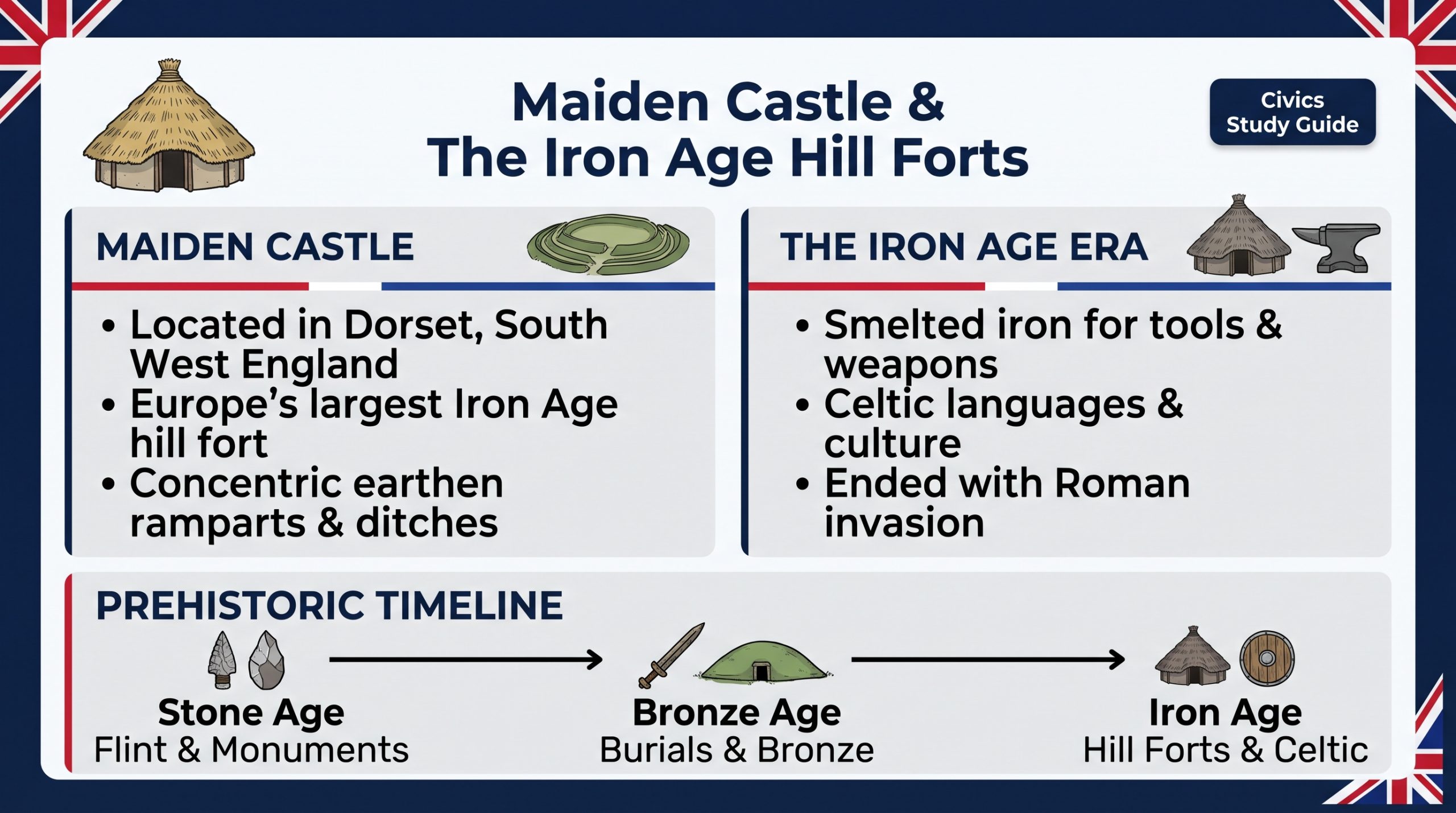
To hit that crucial 75% pass mark meaning 18 correct answers out of 24 you’ve got to remember the exact timeline sequence: the Iron Age came right after the Bronze Age and ended the moment the Romans invaded.
3. Prehistoric Timeline Showdown: Don’t Get Caught Out
Candidates fail history questions when they blur the lines between different prehistoric eras. The Home Office knows this which is why test questions love pairing Stone Age monuments like Stonehenge alongside Bronze Age burial mounds and Iron Age sites like Maiden Castle to see if you’re paying attention.
The Celtic people spoke Celtic languages during the Iron Age (~800 BC–43 AD) and built Maiden Castle using iron tools, whereas the Bronze Age (~2500 BC–800 BC) focused on bronze weapons and round barrow burial mounds, leaving the Neolithic Stone Age (~4000 BC–2500 BC) as the era of early farmers, flint tools, and monumental stone circles like Stonehenge or Skara Brae.
| Criteria / Aspect | Stone Age (Neolithic) | Bronze Age | Iron Age |
|---|---|---|---|
| Time Period | First farmers (~4000 BC – 2500 BC) | ~2500 BC – 800 BC | ~800 BC – 43 AD |
| Primary Metal / Tech | Flint & polished stone tools | Bronze tools, weapons & ornaments | Iron tools, weapons & coinage |
| Key Monuments | Stonehenge, Skara Brae | Round barrows (burial mounds) | Maiden Castle & Hill Forts |
| Language / Culture | Early hunter-gatherers & farmers | Beaker culture & bronze smiths | Celtic languages & tribal hill forts |
Once you see how these eras separate by tech, monuments, and dates, picking the right answer takes zero guesswork.
4. 2026 Interactive Exam Practice Drill
Run through these 5 practice questions to check your knowledge on Maiden Castle, Iron Age history, and early British monuments. These mirror the phrasing and trick options used at official test centers across the UK.
Unfold the drop-down accordion below each question to inspect the official answer and rationale.
Question 1: In which English county can the famous Iron Age hill fort Maiden Castle be found?
View Correct Answer & Rationale
Correct Answer: B) Dorset
Official Rationale: The Home Office handbook explicitly places Maiden Castle in Dorset in South West England. Wiltshire is famous for Stonehenge. Options A, C, and D are incorrect geographic traps.
Question 2: Which historical era in Britain is associated with the construction of Maiden Castle?
View Correct Answer & Rationale
Correct Answer: C) The Iron Age
Official Rationale: Maiden Castle stands as one of Europe’s grandest Iron Age hill forts. Its massive defensive earthworks belong strictly to the Iron Age, which ran up until the Roman invasion in 43 AD.
Question 3: What language family was spoken by the people of Britain during the Iron Age?
View Correct Answer & Rationale
Correct Answer: C) Celtic
Official Rationale: The official text confirms that Iron Age inhabitants spoke Celtic languages. Latin came later with Roman rule, Germanic languages with Anglo-Saxon tribes, and Norman French after 1066.
Question 4: True or False: Maiden Castle was constructed primarily as a stone royal palace for Anglo-Saxon kings.
View Correct Answer & Rationale
Correct Answer: B) False
Official Rationale: Maiden Castle is an earthwork hill fort built in the Iron Age hundreds of years before Anglo-Saxon kings ruled. It wasn’t built of stone, nor was it ever a medieval palace.
Question 5: What event marked the end of the Iron Age in Britain in 43 AD?
View Correct Answer & Rationale
Correct Answer: B) The Roman Invasion under Emperor Claudius
Official Rationale: The British Iron Age officially ended in 43 AD when Emperor Claudius launched the Roman conquest, bringing Britain under Roman rule for nearly four centuries. The Normans arrived in 1066, Vikings hit Lindisfarne in 793 AD, and Magna Carta was sealed in 1215.
Running these practice drills repeatedly builds the rapid recall you need when the exam timer starts ticking.