
How Many MPs in House of Commons Test Numbers: 650 Constituencies & Voting Rules Cheat Sheet
Demographic and constitutional mechanics form the bedrock of the life in the uk test 2027. A recurring hurdle for candidates involves mastering how many mps in house of commons test numbers are formally recognized within the official 3rd edition handbook. This study guide deconstructs the 650 constituencies, evaluates the operational framework of the first-past-the-post voting system, and delineates statutory mandates governing general elections every 5 years, ensuring examinees reach the 75% pass mark (18 out of 24) threshold.
1. Executive Cheat Sheet & Core Summary
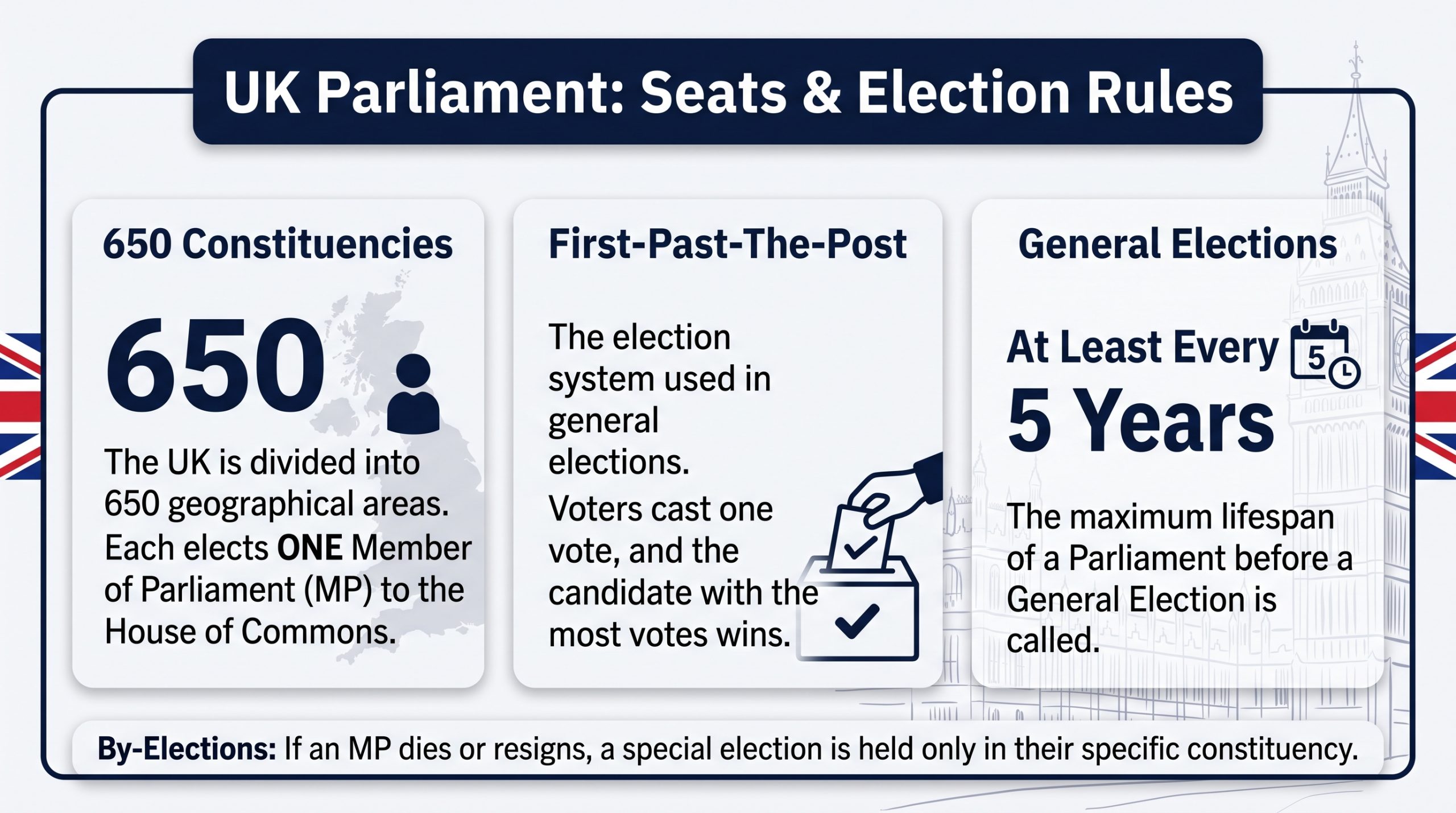
Navigating governance questions requires strict retention of statutory figures. Under the parameters set by the Home Office, the United Kingdom divides into precisely 650 constituencies. Each distinct geographical region elects a single Member of Parliament (MP) to serve within the House of Commons. Citizens select these representatives through general elections every 5 years using the single-winner first-past-the-post voting system.
| Key Metric / Entity | Official Handbook Rule | Exam Trap Warning |
|---|---|---|
| Total MPs in House of Commons | Exactly 650 Members of Parliament. | Candidates must not confuse this number with House of Lords figures. The baseline total remains 650. |
| Number of Constituencies | 650 geographical areas distributed across England, Scotland, Wales, and Northern Ireland. | Every single district returns one representative. Distractor choices offering multi-member representation are inaccurate. |
| Electoral System | First-Past-The-Post (FPTP) voting framework. | Proportional representation models do not govern House of Commons general elections. |
| General Election Frequency | Mandated at least every 5 years. | Examinees often mistake this timeline for four-year presidential cycles used in other nations. |
| Minimum Voting Age | 18 years old for eligible British, Commonwealth, and Irish electors. | Residency alone does not grant voting rights to non-qualifying foreign nationals. |
2. Official 3rd Edition Handbook Breakdown
Chapter 5 of the official curriculum isolates the mechanisms of democratic participation and legal governance. A substantial fraction of exam queries evaluates candidate comprehension regarding parliamentary boundaries and public accountability. Understanding how many mps in house of commons test numbers permeate the live assessment requires examining boundary distributions across the four home nations.
The House of Commons functions as the elected primary legislative chamber. Legislative authority shifted decisively toward the Commons following parliamentary reforms throughout the nineteenth and twentieth centuries. Today, 650 constituencies map the entirety of the United Kingdom, placing every resident within a defined parliamentary boundary.
Boundary commissions recalibrate these geographical zones to maintain comparable population counts, generally hovering between 70,000 and 80,000 registered electors. When reviewing your British citizenship application requirements, remember that democratic franchise extends to all registered citizens aged 18 and older.
Preparing a high-yield cheat sheet for the 24 questions on the computer-based assessment demands strict adherence to specific constitutional parameters:
- 650 Members of Parliament: Exactly 650 seats compose the House of Commons. An MP assumes responsibility for representing all individuals residing within their assigned district boundaries, regardless of personal voting preference or party alignment.
- General Elections Every 5 Years: Parliament dissolves automatically upon reaching a five-year mandate. Although snap elections may occur under designated statutory conditions, five years remains the maximum theoretical threshold tested.
- First-Past-The-Post System: Electors mark a single candidate choice on their ballot paper. Victory belongs to whichever candidate secures a plurality of cast ballots, regardless of whether they cross a majority threshold.
- By-Elections: Mid-term vacancies stemming from death, resignation, or recall trigger localized replacement votes.
3. Comparative Analysis & Concept Clarification
Confusion between the two chambers of Parliament causes frequent candidate errors during testing. The operational distinctions separating elected members from appointed peers demand clear differentiation. The following structural breakdown clarifies key differences documented in the official revision manual.
| Feature / Criteria | House of Commons (MPs) | House of Lords (Peers) |
|---|---|---|
| Selection Method | Elected by eligible citizens across local districts. | Appointed by the Sovereign upon prime ministerial recommendation. |
| Total Membership | Fixed at 650 MPs. | Fluctuates over time without a rigid statutory cap. |
| Electoral System | First-Past-The-Post plurality voting. | No electoral mechanism exists for standard peerages. |
| Term Length | Up to 5 years per parliamentary term. | Life tenure applies to standard appointments. |
| Primary Role | Enacting legislation, authorizing public expenditures, and scrutinizing executive policy. | Revising, delaying, and refining legislative proposals sent from the Commons. |
| Constitutional Authority | Holds ultimate legislative precedence over financial and statutory decisions. | Lacks constitutional power to override financial measures permanently. |
4. Interactive Practice Test & Exam Drills
Consolidate your knowledge using these representative practice test modules. The set includes direct multiple-choice queries, true or false checks, and items requiring multiple selections. Review the accompanying rationales to confirm your baseline readiness.
Question 1: How many constituencies are represented in the UK House of Commons?
View Correct Answer & Rationale
Correct Answer: C) 650
Official Rationale: The Official 3rd Edition Handbook confirms that the United Kingdom contains exactly 650 parliamentary constituencies. Each area returns one Member of Parliament to Westminster. Option A reflects the constituency subtotal for England alone.
Question 2: General elections in the UK are held at least every how many years?
View Correct Answer & Rationale
Correct Answer: C) 5 years
Official Rationale: Under UK constitutional law, a parliament automatically reaches its maximum term five years following its initial meeting. While dissolution may happen earlier, five years serves as the primary statutory interval tested.
Question 3 (True or False): Members of the House of Commons are appointed for life by the Monarch.
View Correct Answer & Rationale
Correct Answer: B) False
Official Rationale: Members of Parliament win office through democratic elections. Life peerages within the House of Lords involve executive appointment and royal approval, not House of Commons seats.
Question 4 (Select TWO Correct Answers): Which TWO of the following statements about voting in UK General Elections are correct?
View Correct Answer & Rationale
Correct Answer: A and D
Official Rationale: Parliamentary elections rely on First-Past-The-Post mechanics to determine winners. Franchise eligibility includes resident British, Irish, and qualifying Commonwealth citizens. Voting eligibility begins at age 18, and constituencies return only one representative.
Question 5: What happens if an MP dies or resigns before the next General Election?
View Correct Answer & Rationale
Correct Answer: C) A by-election is held in that specific constituency.
Official Rationale: A seat vacated during a parliamentary term triggers a targeted by-election. Only voters residing within that specific district participate in selecting the replacement member.