Florence Nightingale & The Birth of Modern Nursing
An unvarnished look at Nightingale’s grueling campaign in the Crimea, her sanitization of the Scutari death traps, the founding of St Thomas’ Training School, and the precise legal historical facts you’ll need for the British citizenship exam.
1. A privileged life rejected: 1820 to 1853
She refused to play the quiet Victorian heiress.
Florence Nightingale was born into opulent luxury on May 12, 1820, while her wealthy parents were touring Florence—the Italian city that gave her a name. Most young women in her social sphere were groomed for polite marriage and domestic leisure, but Nightingale’s father, William Edward Nightingale, broke with convention by tutoring her directly in higher mathematics, multi-language translation, history, and classical philosophy. That mathematical mind changed everything; it gave her the raw analytical weapons she’d later use to overhaul military health through cold, indisputable data visualisations.
By 1837, at just seventeen, she felt a sudden, overriding religious calling to public service. It horrified her family—and understandably so, considering nursing back then wasn’t a respected profession at all, but rather a squalid, low-status trade left to untrained laborers famously lampooned by Charles Dickens through his boozy fictional character Sarah Gamp. Nightingale didn’t yield. She defied her family’s frantic objections for over a decade, finally slipping away to Germany in 1850 and 1851 to undertake formal medical training at the Lutheran Deaconess Institute in Kaiserswerth am Rhein.
She took her first real administrative position in August 1853 as superintendent of London’s Institution for the Care of Sick Gentlewomen on Upper Harley Street. She slashed operating budgets, revamped basic hygiene, reorganized staff shifts, and drove patient mortality downward overnight.
2. The Crimean disaster and the Scutari abattoir
War erupted in March 1854, pitting Britain, France, and the Ottoman Empire against Tsarist Russia. Thanks to newly laid electric telegraph lines, correspondents like William Howard Russell of The Times sent raw, uncensored reports straight to London households detailing how British soldiers were rotting away in mud and filth without basic bandage dressings.
Sickness did the killing, not Russian bullets.
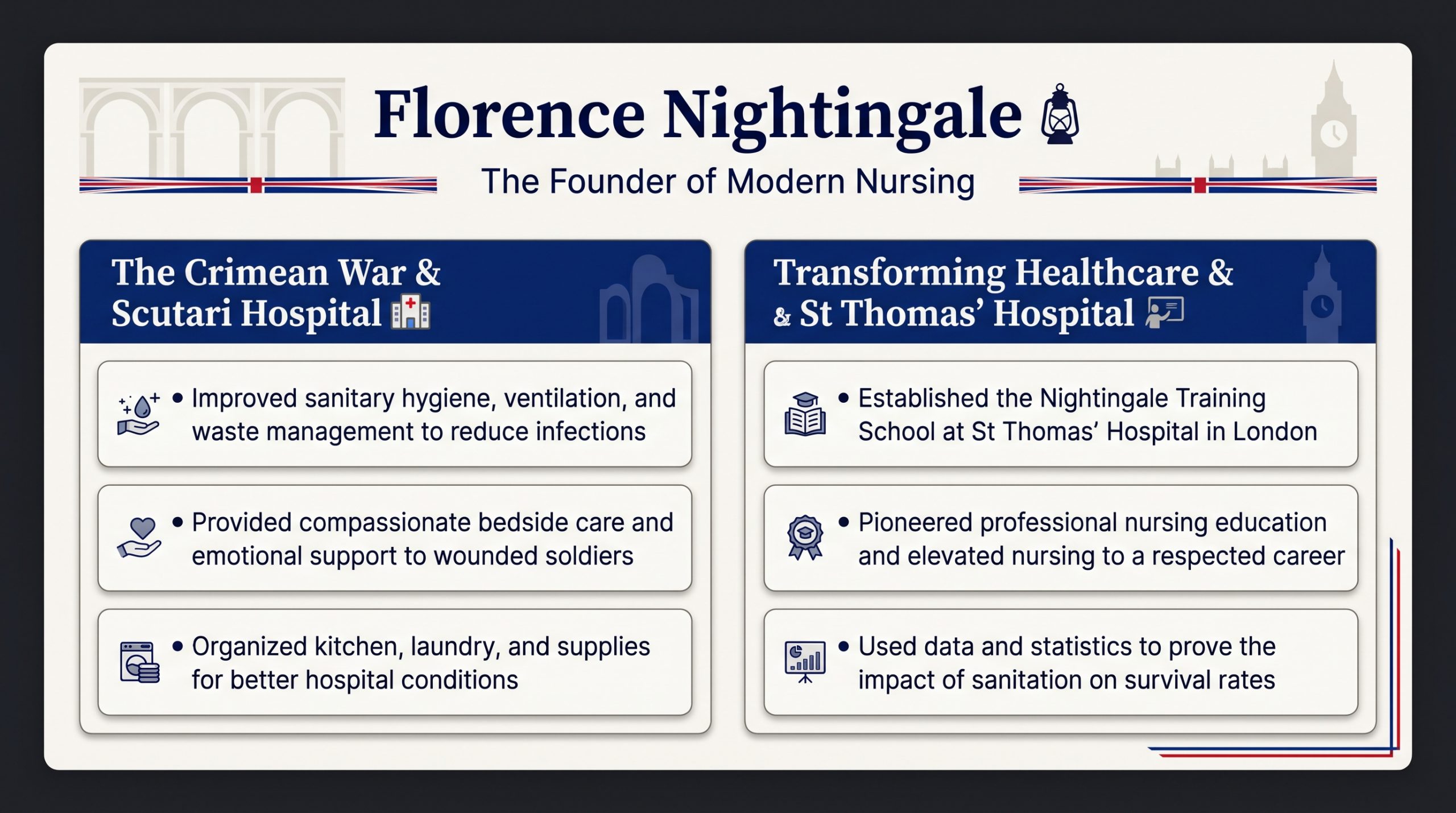
Epidemics of typhus, dysentery, and cholera were wiping out whole regiments before they ever saw a battlefield. Sidney Herbert—the Secretary at War who happened to know Nightingale personally—begged her to organize a private team of female medical workers for the front lines. She recruited 38 women—a mixed group of Catholic nuns, Anglican sisters, and hospital workers—arriving at the main British base at Barrack Hospital in Scutari (now Üsküdar in Istanbul, Turkey) on November 4, 1854.
| Facility / Metric | Condition Upon Arrival (Nov 1854) | Condition After Sanitation Reforms (1855–1856) |
|---|---|---|
| Primary Cause of Death | Preventable infectious diseases (Cholera, Typhus, Dysentery) | Traumatic combat wounds and surgical recovery |
It was a nightmare site built right over a cesspool, leaking sewer gas through every floorboard. Water was rationed, chamber pots overflowed near crowded cots, and doctors treated Nightingale’s team like unwanted meddlers.
3. Drainage, diagrams, and defeating bureaucratic rot
Nightingale targeted the operational collapse immediately. She bought scrub brushes out of private funds, opened a clean laundry service, and set up special kitchens for dysentery patients.
Her late-night checks through miles of crowded wards carrying a small Turkish lamp created her famous myth—”The Lady with the Lamp”—which was immortalized in Henry Wadsworth Longfellow’s 1857 poem Santa Filomena.
Yet despite her clean bedsheets, death rates soared to an astounding 42% by early 1855. It took a government-appointed Sanitary Commission arriving in March 1855—led by Dr. John Sutherland and Robert Rawlinson—to discover that the hospital sat directly over a blocked, decaying sewer line that was actively poisoning the facility’s drinking supply.
The lesson hit Nightingale hard: clean air, unpolluted water, proper drainage, and uncrowded rooms were non-negotiable requirements for keeping human beings alive. To prove it to Parliament, she created her famous “coxcomb” polar area diagrams, visually proving that preventable filth killed far more troops than combat ever did.
4. St Thomas’ Hospital: Building a professional army of nurses
When Nightingale stepped back onto English soil in August 1856, she avoided public parades entirely, opting instead to direct reform from her quiet London home. Her admirers had already raised £44,000 through the public Nightingale Fund, giving her the capital she needed to reshape civilian medicine.
She invested those funds directly into founding the Nightingale Training School for Nurses at London’s St Thomas’ Hospital on July 9, 1860, turning an unsanitary, mocked occupation into a respected, scientifically grounded profession for women. Her core philosophy was published in her iconic 1859 book, Notes on Nursing: What It Is, and What It Is Not, which laid down five mandatory environmental pillars: fresh air, clean water, proper drainage, spotless rooms, and natural light.
Her influence stretched far beyond hospital wards; she helped establish district home-nursing programs with reformer William Rathbone in Liverpool, advised the Colonial Office on sanitation projects across British India, and laid down the structural blueprints that eventually became the Royal Army Medical Corps.
Recognizing a lifetime of monumental work, King Edward VII made her the first woman ever to receive the Order of Merit in 1907. She died peacefully in her sleep at her Mayfair residence on August 13, 1910, at 90 years old, leaving behind a modern global health architecture built on data, hygiene, and human dignity.
5. High-yield practice drills & exam questions
Check your recall against these exact Life in the UK exam-style practice questions.
Question 1: Which war brought Florence Nightingale to public attention for her work in improving hospital conditions? (Click to reveal answer)
Correct Answer: The Crimean War.
Explanation: Nightingale brought 38 nurses to Scutari’s Barrack Hospital during the Crimean War (1853–1856) to treat wounded British soldiers, bringing her international fame and transforming military healthcare practices.
Question 2: What was the name of the hospital where Florence Nightingale established her famous training school for nurses in 1860? (Click to reveal answer)
Correct Answer: St Thomas’ Hospital, London.
Explanation: She launched the Nightingale Training School for Nurses at St Thomas’ Hospital on July 9, 1860, using public money collected through the Nightingale Fund.
Question 3: True or False: Florence Nightingale was the first woman to receive the British Order of Merit. (Click to reveal answer)
Correct Answer: True.
Explanation: King Edward VII awarded Florence Nightingale the Order of Merit in 1907, marking the first time in British history the honor was given to a woman.
Question 4: What popular nickname was given to Florence Nightingale during her time serving in Scutari? (Click to reveal answer)
Correct Answer: “The Lady with the Lamp”.
Explanation: The wounded soldiers called her “The Lady with the Lamp” because she regularly walked through the dark, massive hospital corridors at night checking on patients with a small lantern.
6. Essential exam questions answered
Why is Florence Nightingale featured prominently in the Life in the UK Test?
She’s a central historical figure who modernized public healthcare, professionalized nursing for women, and pioneered statistical graphics in government policy across the British Empire.
What was the key cause of high death rates at Scutari before the Sanitary Commission arrived?
Raw sewage leaks, contaminated drinking water, terrible ventilation, and overcrowded wards caused deadly outbreaks of cholera, typhus, and dysentery that killed far more men than battle wounds ever did.
When did Florence Nightingale live?
Nightingale lived from May 12, 1820, to August 13, 1910, spanning almost the entirety of the Victorian era into the early 20th century.