
Boudicca & The Iceni Revolt : Common Exam Traps & Tricky Test Distractors
When Queen Boudicca led the Iceni tribe in an all-out revolt against Roman rule in AD 60, her warriors reduced three key settlements to ash: Camulodunum (Colchester), Londinium (London), and Verulamium (St Albans). Test writers at the Home Office love this topic. They’ll routinely swap in later Anglo-Saxon or Celtic tribal names to catch out unprepared candidates, making exact recall of these towns, dates, and lineage non-negotiable for passing your exam.
1. Tribal Mutiny: Quick Facts & Trap Summary
Chapter 3 of Life in the United Kingdom: A Guide for New Residents doesn’t mince words about early British resistance. You aren’t being tested on military tactics; the Home Office cares strictly about precise historical anchors. Mix up a single town or misdate the uprising, and you’ll drop easy marks on questions that take five seconds to lock down.
Zero in on the specific historical markers, tribal names, and geographical distractors mapped below before moving into the deeper narrative.
| Key Metric / Legal Entity | Official Handbook Rule | Common Exam Trap |
|---|---|---|
| Tribal Identity | Commanded the Iceni tribe in eastern Britain (modern East Anglia). | Falling for distractors that swap the Iceni with the Brigantes, generic Celts, or later Anglo-Saxon invaders. |
| Historical Date | Rebellion broke out in AD 60 smack in the middle of the 1st Century AD. | Confusing AD 60 with 55 BC (Caesar’s initial reconnaissance) or AD 43 (Claudius’s full invasion). |
| 3 Destroyed Towns | Camulodunum (Colchester), Londinium (London), and Verulamium (St Albans). | Picking York (Eboracum), Bath (Aquae Sulis), or Winchester settlements never sacked by the Iceni. |
| Current Capital Legacy | Her iconic bronze statue stands proudly next to Westminster Bridge right by Parliament in London. | Assuming the memorial sits in Colchester or somewhere in East Anglia where her tribe originated. |
Memory traps abound.
The Home Office isn’t assessing your nuanced take on anti-imperial warfare; their software relies on direct, binary fact-matching pulled straight from the 3rd Edition handbook. If you memorize these specific details, you won’t get caught out by clever wording on test day.
2. Historical Anatomy of the AD 60 Uprising
Roman legionaries landed in force in AD 43 under Emperor Claudius, securing control across southern Britain through a mix of military posts and local client-king treaties. It was a fragile peace. When King Prasutagus of the Iceni passed away, Roman tax collectors ignored his written request to split his estate between his daughters and the Roman state. Imperial officers seized the kingdom outright, publicly flogging his widow Boudicca and brutalizing her daughters. That massive blunder sparked a bloody tribal coalition.
As documented in Roman archives preserved at the British Museum, Boudicca rallied neighboring tribes who’d grown desperate under heavy Roman taxation and forced land confiscations. Her forces targeted Roman symbols of civic power, burning down administrative settlements before the imperial governor could marshal a proper defense.
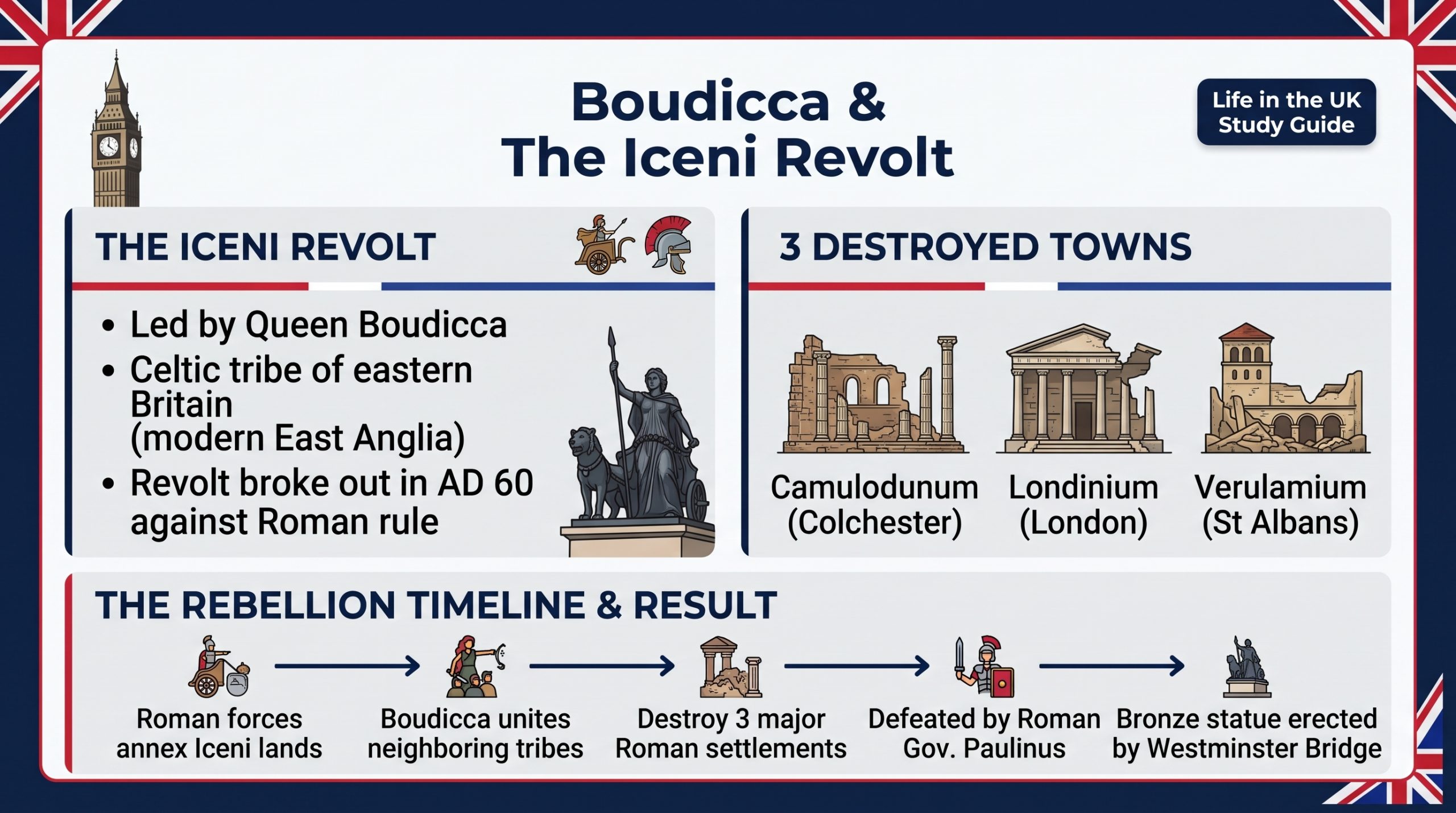
Camulodunum fell first. As the capital of Roman Britain and home to a massive temple dedicated to the late Emperor Claudius, it was a target of immense symbolic rage. Iceni warriors breached the town defenses, slaughtered the garrison, and left the city in cinders. Boudicca then turned her war bands south toward Londinium, a booming commercial port on the Thames.
The Roman Governor, Suetonius Paulinus, realized he lacked the manpower to hold London and abandoned the settlement to save his army. Boudicca burnt it to the ground. She then marched her army northwest to level Verulamium, executing its inhabitants and destroying its civic infrastructure.
It didn’t last.
Though her scorched-earth campaign devastated early Roman Britain, Paulinus eventually picked a narrow battle site to break the larger Celtic forces. Boudicca’s defeat restored Roman military control, but her defiance secured her spot as one of Britain’s earliest national icons. If you’re cross-referencing early British legal records through the National Archives, her rebellion marks the absolute bedrock of recorded British history and a staple of your 24-question test paper.
3. Sorting Early British Figures: Who’s Who?
Candidates crash out when the exam mixes up early historical figures. It’s surprisingly easy to blur Celtic leaders, Roman emperors, and Anglo-Saxon kings when you’re rushing through multiple-choice options under time pressure. The test relies on this exact confusion.
You can safeguard your score by keeping these three distinct handbook figures separated by era, role, and geography.
| Criteria / Aspect | Queen Boudicca | Emperor Claudius | King Alfred the Great |
|---|---|---|---|
| Historical Era | Roman Britain (1st Century AD / AD 60) | Roman Invasion (1st Century AD / AD 43) | Anglo-Saxon Period (9th Century AD) |
| Role / Identity | Queen of the Iceni (Celtic Tribal Leader) | Roman Emperor who conquered Britain | King of Wessex who united Anglo-Saxons |
| Primary Achievement | Led major revolt; destroyed 3 Roman towns | Established Roman provincial control | Defeated the Vikings; established Danelaw boundary |
| Syllabus Key Location | Colchester, London, St Albans, Westminster | Rome / Imperial Britain garrisons | Wessex / Anglo-Saxon kingdoms |
Timing is everything.
Claudius kicked off the successful Roman conquest in AD 43, while Boudicca’s uprising exploded seventeen years later in AD 60. Neither has anything to do with King Alfred, who defended Wessex against Viking invaders a full eight centuries down the line. Keep your centuries straight, and you won’t fall for the exam’s era-blending distractor choices.
4. Live Exam Mock Drill & Instant Rationales
Ready to see how the Home Office frames this topic? Work through these authentic practice questions built to mirror the exact computer-based test interface you’ll face at the assessment centre. Pick an option, then pop open the rationale box to check your reasoning.
Question 1: Which ancient tribe was led by Queen Boudicca during the AD 60 revolt against Roman rule?
- A) The Brigantes
- B) The Iceni
- C) The Picts
- D) The Saxons
Click to view correct answer and rationale
Correct Answer: B) The Iceni
Handbook Rationale: Chapter 3 explicitly names Queen Boudicca as leader of the Iceni, a Celtic tribe based in eastern Britain (modern-day East Anglia). The other choices are classic exam bait: the Brigantes held the north, the Picts controlled far northern Scotland, and the Saxons didn’t arrive until Roman rule collapsed centuries later.
Question 2: Which three Roman towns were burned and destroyed by Boudicca’s tribal forces in AD 60?
- A) London, York, and Bath
- B) Colchester, London, and St Albans
- C) St Albans, Chester, and Lincoln
- D) Winchester, Canterbury, and Colchester
Click to view correct answer and rationale
Correct Answer: B) Colchester, London, and St Albans
Handbook Rationale: Home Office material underlines the destruction of three specific urban centers: Camulodunum (Colchester), Londinium (London), and Verulamium (St Albans). Lock this triplet in your memory; other options mix in real Roman locations that weren’t part of Boudicca’s campaign.
Question 3: Where in London can a famous statue of Queen Boudicca be seen today?
- A) Outside the Tower of London
- B) In Trafalgar Square
- C) Next to Westminster Bridge near Parliament
- D) Inside St Paul’s Cathedral
Click to view correct answer and rationale
Correct Answer: C) Next to Westminster Bridge near Parliament
Handbook Rationale: As noted in official study guides, a prominent bronze statue depicting Boudicca in her war chariot stands beside Westminster Bridge, right next to the Houses of Parliament in central London.
Question 4: True or False: Queen Boudicca successfully drove the Romans out of Britain permanently in AD 60.
- A) True
- B) False
Click to view correct answer and rationale
Correct Answer: B) False
Handbook Rationale: Don’t get tripped up here! Although her forces laid waste to three vital cities, Roman legions regrouped and broke the revolt. Imperial rule stayed firmly in place across Britain until legions withdrew in AD 410.
Running timed practice questions helps smooth out test anxiety while getting you comfortable with the strict syntax used by Home Office test setters.