Ancestry of Stonehenge Builders : Key Differences & Test Traps for Life in the UK Exam
Six thousand years ago around 4000 BC small bands of migrants crossed the Channel from South-East Europe, carrying seeds, stock, and stone technology that permanently upended Britain’s wild landscape. They weren’t simple wanderers; these early agriculturalists built monumental stone circles, established permanent farmsteads, and laid down the genetic foundation for the builders of Stonehenge. If you’re tackling Chapter 3 of the Home Office manual, mastering this exact migration and learning how to spot the examiner’s favorite chronological traps is often the difference between a quick pass and a costly retake.
1. First Farmers South-East Europe Migration Fast Facts & Key Summary
The Home Office’s official publication, Life in the United Kingdom: A Guide for New Residents (3rd Edition), opens its historical breakdown by charting how nomadic hunter-gatherers vanished as settled agricultural societies took hold across the island.
You’ll face specific questions on exact dates, geographic origins, and physical structures. Memorize the core metrics below.
| Key Metric / Legal Entity | Official Handbook Rule | Common Exam Trap |
|---|---|---|
| Migration Origin | First farmers migrated from South-East Europe into Britain around 6,000 years ago (4000 BC). | Confusing South-East European farming ancestors with later Bronze Age Beaker people or Iron Age Celts. |
| Stonehenge Builders | Constructed by Neolithic farming communities in Wiltshire; standing stones were erected over a long period. | Mishandling questions claiming Stonehenge was built by Romans, Anglo-Saxons, or Druids. |
| Skara Brae | Best-preserved Neolithic village in Europe, located on Orkney, off the northern coast of Scotland. | Misplacing Skara Brae in England or Wales, or misidentifying it as an Iron Age hill fort. |
| Monuments & Burial | Early farmers built earth barrows, stone circles, and megalithic monuments for ritual and burial purposes. | Assuming hunter-gatherers built permanent stone monuments prior to the arrival of agriculture. |
Lock these details down early.
2. What Chapter 3 Actually Expects You to Know About Prehistoric Britain
For millennia after the last glacial retreat, tiny family groups trailed herds across Britain’s thick forests, surviving entirely on wild game, river fish, and seasonal roots. Then came the shift. Around 4000 BC, seafaring families hailing originally from South-East Europe worked their way across the Continent, bringing cereal crops, domesticated sheep, cattle, and pottery-making skills directly to British shores.
It was a total economic reset. As these families cleared land and planted wheat, population numbers spiked giving early communities both the settled security and the sheer labor power needed for massive earth-moving projects. According to official testing standards managed by the UK Home Office, candidates aren’t required to dive deep into carbon-dating science, but you must know that this single migration brought farming to the British Isles.
Once settled, these farmers reshaped the countryside.
They built long earth barrows for communal burials alongside massive timber and stone enclosures for seasonal rituals. The most celebrated of these sites Wiltshire’s famous Stonehenge wasn’t thrown up overnight. It evolved across hundreds of years, starting as a simple earthen ditch and ring bank before later generations hauled massive sarsen blocks and Welsh bluestones into place.
Further north, offshore weather preserved another major piece of the official curriculum: Skara Brae on Mainland, Orkney. Uncovered when a violent storm stripped away sand dunes in 1850, this stone village features intact hearths, built-in stone beds, and storage units built by Neolithic families roughly 5,000 years ago. It stands as Western Europe’s clearest window into early domestic life, built long before Roman legions set foot in Kent. If you want to explore the physical artifacts recovered from these sites, check out the public online collections at the British Museum or review historical land preservation records at the National Archives.
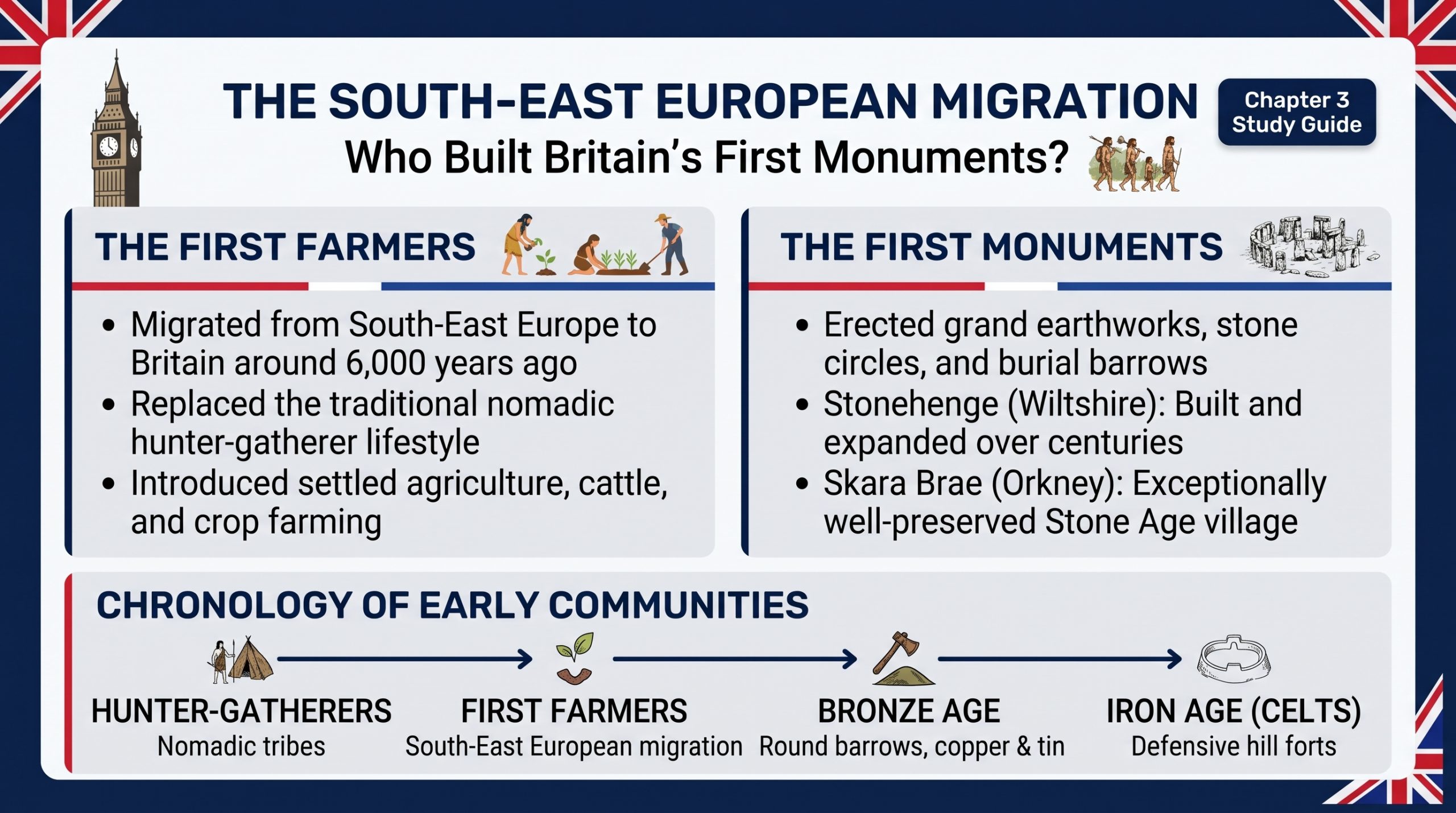
The exam tries to scramble these eras. Keep your timeline straight: Stone Age farmers (from South-East Europe) built the stone circles; Bronze Age communities arrived around 2000 BC (introducing round barrows and tin-copper alloys); and Iron Age Celts came later, building defensible hill forts across the British landscape.
3. Breaking Down Prehistoric Eras: Where Most Test-Takers Lose Marks
You can’t afford to confuse Stone Age builders with Iron Age warriors. The test writers rely heavily on subtle historical overlaps to write convincing wrong answers, so separating these four distinct cultural waves is critical if you’re aiming for a clean score above 75%.
Instead of memorizing endless paragraphs, use this direct era-by-era breakdown to compare how each group lived, built, and farmed across early British history.
| Criteria / Aspect | Hunter-Gatherers (Mesolithic) | First Farmers (Neolithic) | Bronze Age Communities | Iron Age Communities (Celts) |
|---|---|---|---|---|
| Approximate Date | Before 4000 BC | c. 4000 BC (6,000 years ago) | c. 2000 BC (4,000 years ago) | c. 800 BC – AD 43 |
| Ancestral Origins | Indigenous post-glacial tribes | Migrants from South-East Europe | Continental European trade/migrants | Celtic culture across Europe |
| Key Physical Monuments | Temporary shelters, natural caves | Stonehenge, Skara Brae, Long Barrows | Round Barrows, bronze weaponry sites | Hill forts (e.g., Maiden Castle) |
| Primary Economic Activity | Hunting game, fishing, foraging | Cereal farming, animal husbandry | Metalworking (copper + tin), trade | Iron forging, agriculture, coinage |
Focus on the shifts. Hunter-gatherers moved constantly without leaving heavy masonry behind; South-East European farmers built permanently with earth and stone; Bronze Age populations introduced alloy metalwork and round burial mounds; and Iron Age Celts built massive defensive hill forts like Dorset’s Maiden Castle.
4. Practice Questions: Test Your Knowledge of Chapter 3
These practice questions reflect the phrasing, structure, and options you’ll face during your 24-question test session at an official center.
Work through each question, select your response, and open the accordion box beneath to review the official Home Office reasoning.
Question 1: Where did the first farmers who settled in Britain approximately 6,000 years ago originally migrate from?
View Correct Answer & Rationale
Correct Answer: B) South-East Europe
Official Rationale: Chapter 3 states clearly that Britain’s first agriculturalists arrived roughly 6,000 years ago from South-East Europe. They introduced crop cultivation, domesticated herds, and settled village life. Options A, C, and D are incorrect geographically and don’t feature in the official handbook’s account of this migration wave.
Question 2: Which famous prehistoric monument in Wiltshire was built by early farming communities over a long period of time?
View Correct Answer & Rationale
Correct Answer: C) Stonehenge
Official Rationale: Stonehenge, standing in Wiltshire, was raised and expanded over centuries by Neolithic agriculturalists. Option A (Maiden Castle) is an Iron Age hill fort; Option B (Hadrian’s Wall) was constructed by Roman legions starting in AD 122; and Option D (Offa’s Dyke) is an 8th-century Mercian border earthwork built under King Offa.
Question 3: Where is the exceptionally well-preserved Stone Age village of Skara Brae located?
View Correct Answer & Rationale
Correct Answer: B) Orkney, off the north coast of Scotland
Official Rationale: Skara Brae sits on Orkney, an island group off Scotland’s northern coast, and remains Western Europe’s best-preserved Neolithic settlement. Option A is where you’ll find Stonehenge; Options C and D point to distinct locations in Wales and Northern Ireland that have nothing to do with this ancient village.
Question 4: What major economic and social transition occurred in Britain approximately 6,000 years ago?
View Correct Answer & Rationale
Correct Answer: B) The shift from nomadic hunter-gathering to settled agriculture
Official Rationale: Around 4000 BC (6,000 years ago), incoming South-East European farmers introduced agriculture, ending Britain’s long reliance on hunter-gatherer mobility. Option A describes the Roman invasion (AD 43); Option C relates to the Iron Age (c. 800 BC); and Option D points to religious shifts during the late Roman and Anglo-Saxon eras.
Question 5: Which metal was combined with copper around 4,000 years ago to mark the beginning of the Bronze Age in Britain?
View Correct Answer & Rationale
Correct Answer: B) Tin
Official Rationale: Near 2000 BC (4,000 years ago), ancient islanders learned to fuse copper with tin to forge bronze, kicking off the Bronze Age an era known for new metal weapons, tools, and round burial barrows. Option A (Iron) belongs to the later Iron Age, while Options C and D (silver and gold) were reserved for decorative items and early coinage rather than bronze making.
Review these answers carefully. Practice makes perfect.