Alexander Fleming Penicillin Life in the UK Test: 1928 Discovery, Oxford Synthesis & World War II Medical Deployment
Sir Alexander Fleming’s 1928 identification of penicillin remains a cornerstone of the official 3rd edition handbook syllabus for the Life in the UK Test 2026. Understanding the trajectory from initial laboratory observation to industrial mass production during World War II requires examining the distinct roles played by Fleming, Howard Florey, and Ernst Chain, alongside the institutional frameworks that transformed modern therapeutics.
1. Executive Cheat Sheet & Core Summary
Modern British history questions in the 24-question test frequently interrogate twentieth-century scientific advancements. Candidates seeking the 75% pass mark (18 out of 24) must differentiate the initial accidental laboratory detection of penicillin from the subsequent chemical isolation and clinical translation. The Home Office syllabus tests precise knowledge regarding individual contributions, institutional timelines, and public health outcomes associated with this therapeutic development.
| Key Metric / Entity | Official Handbook Rule | Exam Trap Warning |
|---|---|---|
| Sir Alexander Fleming | Scottish bacteriologist who observed bacterial inhibition by mold in 1928 at St Mary’s Hospital, London. | Candidate options incorrectly attribute clinical stabilization or mass industrial scaling directly to Fleming alone. |
| Year of Discovery | In 1928, contaminating culture plates yielded the active isolate Penicillium notatum. | Distractor options frequently substitute adjacent wartime dates such as 1918, 1939, or 1945. |
| Howard Florey & Ernst Chain | Dunn School of Pathology researchers at Oxford University who purified the compound for therapeutic administration. | Multiple-choice items requiring two options test Florey and Chain jointly as developers of the clinical agent. |
| Nobel Prize in Medicine | Conferred jointly in 1945 upon Fleming, Florey, and Chain for therapeutic discovery and application. | Test prompts false claims that Fleming received sole unshared international recognition for the discovery. |
| WWII Mass Production | Industrial scaling by British and American pharmaceutical entities preserved Allied military manpower. | The handbook distinguishes World War II deployment from earlier conflicts like World War I where antibiotics were absent. |
2. Official 3rd Edition Handbook Breakdown
The official 3rd edition study guide (Life in the United Kingdom: A Guide for New Residents) positions Sir Alexander Fleming alongside major figures of British intellectual history. The curriculum emphasizes both chronological precision and the collaborative nature of modern scientific inquiry.
Historical Context: From Laboratory Observation to Clinical Utility
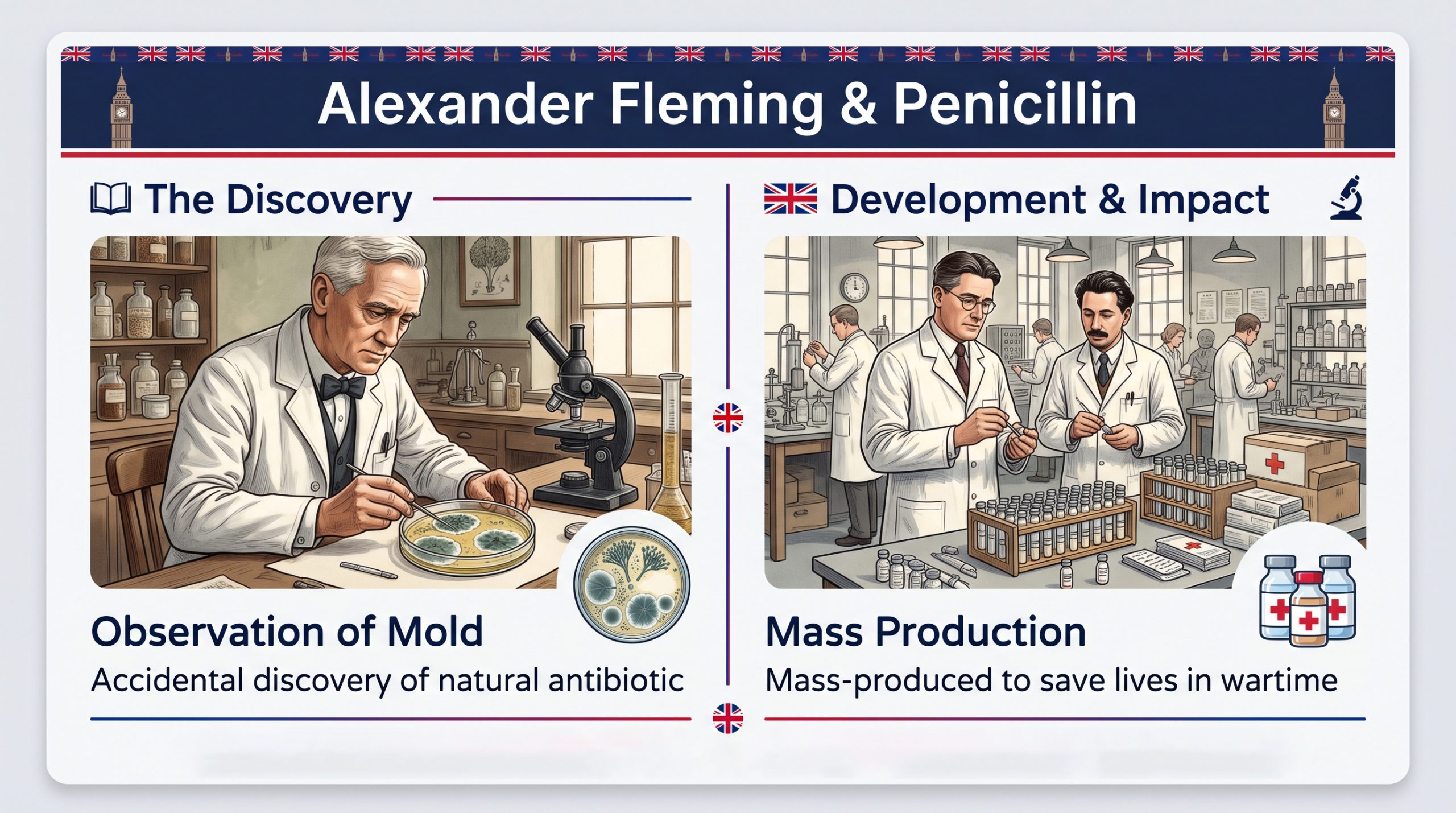
In September 1928, Fleming observed staphylococcal lysis on an exposed culture plate at St Mary’s Hospital in London. The fungal agent, designated Penicillium notatum, exuded a bactericidal filtrate capable of destroying pathogenic microorganisms. Although Fleming published his observations in the British Journal of Experimental Pathology in 1929, biochemical instability and low production yields hampered immediate clinical application. His original paper documented antibacterial efficacy while acknowledging the technical difficulties of extracting stable, concentrated active fractions.
Systematic purification occurred a decade later through the research program of pathologist Howard Florey and biochemist Ernst Chain at the Sir William Dunn School of Pathology, Oxford. Supported by the Rockefeller Foundation and the Medical Research Council, the Oxford team demonstrated in 1940 that purified penicillin protected laboratory mice against fatal streptococcal infections. Subsequent clinical trials on human subjects in 1941 confirmed therapeutic value, though wartime manufacturing limitations in Great Britain prompted Florey to seek industrial assistance from American pharmaceutical firms. Transatlantic manufacturing initiatives enabled large-scale supply by 1944, transforming military field medicine during the Allied Normandy landings.
3. Analytical Breakdown & Concept Clarification
Securing the required passing score demands distinguishing individual historical roles from institutional research outcomes. The analytical matrix below delineates the key parameters tested in the official examination environment.
| Evaluation Axis | Sir Alexander Fleming | Howard Florey & Ernst Chain |
|---|---|---|
| Primary Innovation | Initial identification of bacterial lysis caused by Penicillium notatum in 1928. | Biochemical purification, freeze-drying stabilization, and animal/human clinical protocols. |
| Institutional Base | St Mary’s Hospital, London (Infection and Immunity research domain). | Sir William Dunn School of Pathology, Oxford University. |
| National Origin | Scottish (born in Darvel, Ayrshire, Scotland). | Howard Florey (Australian-born); Ernst Chain (German-born naturalized British subject). |
| War Effort Application | Identified potential topical antiseptic properties during World War I medical service. | Engineered transatlantic industrial fermentation protocols operational for the 1944 Normandy landings. |
4. Interactive Practice Test & Exam Drills
Evaluate your retention of the handbook material with these exam-style questions structured according to Home Office testing patterns.
Question 1: In which year did Scottish scientist Sir Alexander Fleming discover penicillin?
View Correct Answer & Rationale
Correct Answer: B
Official Rationale: Alexander Fleming observed the antibacterial properties of penicillin mold in 1928 at St Mary’s Hospital in London, establishing the foundation for modern antibiotic therapy.
Question 2: Which two scientists successfully purified penicillin and developed methods for its mass production? (Select TWO options)
View Correct Answer & Rationale
Correct Answer: A and C
Official Rationale: Howard Florey and Ernst Chain led the Oxford research group responsible for isolating the drug and managing manufacturing scale-up during World War II.
Question 3: Is the following statement True or False? “Sir Alexander Fleming received the Nobel Prize in Medicine in 1945 without co-recipients.”
View Correct Answer & Rationale
Correct Answer: B (False)
Official Rationale: The 1945 Nobel Prize in Physiology or Medicine was awarded jointly to Alexander Fleming, Howard Florey, and Ernst Chain for their combined scientific achievements.
Question 4: In which part of the United Kingdom was Sir Alexander Fleming born?
View Correct Answer & Rationale
Correct Answer: C
Official Rationale: Fleming was born in Ayrshire, Scotland. The official handbook explicitly tests national backgrounds of key British historical figures.
Question 5: What primary historical factor accelerated the industrial mass production of penicillin?
View Correct Answer & Rationale
Correct Answer: B
Official Rationale: The need to treat infectious wounds among Allied military casualties during World War II drove international production partnerships.
5. Frequently Asked Questions
How are Fleming’s discoveries tested on the Life in the UK examination?
Test items focus on three specific elements: identifying 1928 as the year of initial laboratory observation, identifying penicillin as the discovered agent, and recognizing Howard Florey and Ernst Chain as the co-developers who enabled clinical deployment.
Is detailed biochemical knowledge required to answer scientific history questions?
Scientific mechanisms are excluded from evaluation. The examination tests historical facts, geographical associations, dates, and historical figures explicitly outlined in the Home Office publication.
What procedural rules apply if a candidate fails to achieve the 75% pass threshold?
Under official test center rules, candidates failing to achieve 18 correct answers must observe a mandatory 7-day waiting period prior to rebooking. Rebooking incurs a standard fee per attempt without structural limits on total attempts.
Does passing the Life in the UK test satisfy settlement requirements?
A pass certificate satisfies the Knowledge of Language and Life (KLL) requirement for Indefinite Leave to Remain (ILR) and British naturalization applications, provided the applicant is not exempt due to age or documented medical conditions.